Summary
Xima is a new three-dimensional science game of Cuban origin, designed to allow more than two players to compete simultaneously. It can be played either in a competitive mode or incorporating elements of chance. Furthermore, it introduces a new classification genre for board games, known as Scienluck, which uniquely allows players to engage with or without randomness within the same match. Xima is a game of personal growth that is very easy to learn. It helps develop various skills such as observation, logic, spatial memory, and creativity.
The goal of this book is to introduce a new system of magnitudes to describe the dynamics experienced in board games, specifically applied to Xima. Concepts such as force, power, and level of play are introduced. Additionally, a formula is presented that allows the calculation of a player's relative skill, called CIMAX, which is based not only on scores achieved in previous games but also on the actual development of ongoing matches.
The book provides detailed steps to calculate each of these magnitudes, explains what they represent, how they are interpreted, and why they are useful. The incorporation of these measurements makes Xima particularly exciting for spectators, as comparing scores becomes much easier for both new players and the general public to understand.
Several sample games are also included for strategic analysis, and they are used to calculate Xima's magnitudes. In addition, the book explores the history of board games and presents a fairly accurate quantitative comparison of the number of possible combinations in various board games, comparing Xima to Chess, Go, and Checkers.
What is new in XIMA
- Easy-to-learn three-dimensional science game, allowing two, three, four, or more players to play at the same time, even in pairs. The board's dimensions and the number of possible combinations make it possible for several players to play in the same match, ideal for playing in pairs, with family, and friends.
- The world's first hybrid board game that can be played with or without luck. It introduces a new genre in board games called Scienluck. XIMA can be played in sports mode, in luck mode with dice, and also in a combined mode during the same match, known as Scienluck. This new mode allows one player to use dice while the other does not, blending luck with strategic skill, making it very fun and entertaining.
- Features a new system for measuring and calculating the force, level, power, and excitement during gameplay. XIMA introduces a new scoring system called CIMAX, a mathematical method that incorporates variables such as the player’s movement and performance during the match to calculate the relative skill of the players. It also includes dynamic magnitudes calculated each turn, such as gameplay force, power, and playing level, making it highly entertaining from a spectator's point of view.
- Develops cognitive skills through three-dimensional analysis and calculation abilities. It contributes to mental and intellectual development for those who play it. It helps to cultivate clear, logical, and combinatorial thinking. With more than 1.7 trillion possible combinations just by the second turn in a two-player game, it boosts memory and creativity. During gameplay, the frontal lobe and both hemispheres of the brain are engaged to forecast future moves, create ideas, and calculate the general situation of the match. It plays an important role in brain development, especially in children and growing students. It is also suitable for teaching concentration and integral judgment.
- It is a game without draws; there is always a winner who reaches the top (Xima) first. At a professional level, many competitive board games face the problem of frequent draws, such as chess, where many grandmaster matches end in ties, making it less exciting for spectators. XIMA solves this issue: draws do not exist, as completely dominating all enemy blocks and leaving the opponent without moves results in defeat. If players lack resources to reach the top, a rule provides both players with new blocks to keep the game flowing.
- A healthy game with a noble and peaceful objective, where winning is about building your own path to the top rather than destroying or killing opponents. It does not promote racism; its blocks and squares are vibrant colors like yellow, blue, orange, and green. The board inspires spiritual harmony; all blocks are identical, avoiding social class distinctions, racism, and slavery. The core teaching of the game is personal growth.
- It includes a very simplified algebraic notation system, easy to write and read. Despite being a three-dimensional game, the notation system is simplified to a two-dimensional 13x13 board, which is easy to learn.
- The first board game in human history with a sporting nature created by known authors. XIMA was created in Cuba in 2010 by Physical Culture graduate Yosdel Vicente Muiño Acevedo and Doctor Liz Power Suarez. Although Chess and Go are also sports-like board games, their original creators are unknown, with only myths and unproven theories about their origins.
- The law of gravity is evidenced as part of the game's dynamics. The XIMA blocks experience gravitational phenomena, especially during the capture of blocks, helping players understand the concept of gravity.
Rules and Objectives of the XIMA Game
1. At the beginning of the game, all the blocks (10), including the special one, will be off the board.
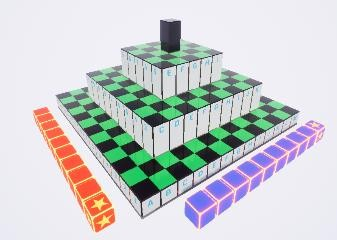
2. Each player will move once per turn. They can either add or move a block up any of the pyramid faces.
3. On their turn, the player can choose to add a new block or move one of the blocks they already have on the board.
4. Blocks move in a straight line in all directions, whether vertical, horizontal, or diagonal, for as many steps as desired, or in the case of playing in chance mode, the number of steps indicated by the dice.
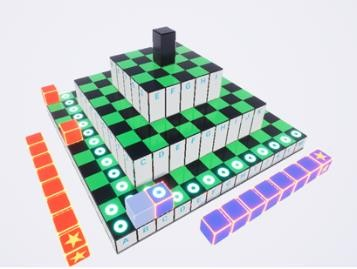
5. When adding a block, it must always be placed on the board.
6. Blocks cannot move off the board once they are in play.
7. If a player on their turn has all their blocks immobilized, they will be declared drowned and will be the winner. Completely immobilizing the opponent is not allowed and will result in a defeat.
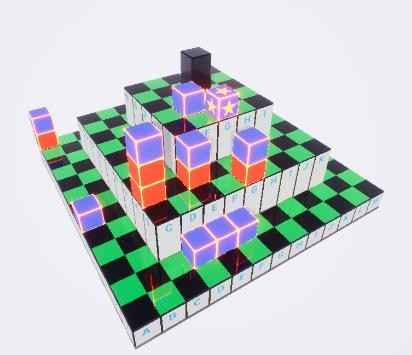
8. To move up from one level to another, blocks must do so by passing over another block, moving in a proportional staircase. No conditions are required to move down.
9. If a player moves a block on the board and in its last step it lands on top of one or more blocks, it immobilizes all the blocks beneath it.
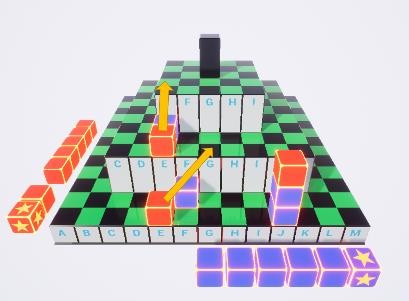
10. If a special block is captured, the affected player can bring a common block to the top of the board and in exchange can rescue the special block, which can be reintroduced into play at any desired moment as if for the first time.
11. When a block moves on top of another block(s) and in that column has a majority color, it will eliminate from the game all those that are in the minority in that same column.
12. A player who loses all their blocks will lose the game.
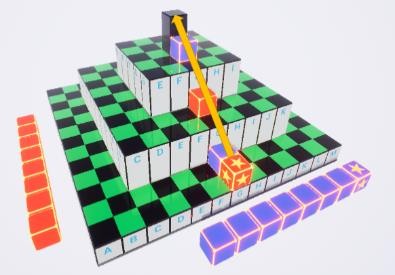
13. If both players have insufficient material to win the game, 3 blocks will be added to each player, which they can incorporate into the game whenever they wish.
14. If, despite having sufficient material to reach the peak, the game level does not progress in 20 turns, 3 blocks will be added to each player.
15. The same position cannot be repeated three consecutive times in a game.
XIMA Game Board
The XIMA board consists of four levels, forming a discrete pyramid shape. From a two-dimensional view, it would be a 13x13 square board, a total of 169 accessible squares, compared to chess which has an 8x8 two-dimensional board with 64 accessible squares. This is just from a two-dimensional perspective, but in reality, each block moves in a three-dimensional space with access to a 13x13x13 board, a total of 2197 accessible squares, a very large number compared to the 64 in chess and the 361 of a 19x19 Go board. This number of possible positions in XIMA gives it a wide range of combinations, strategies, openings, and endgames, making it difficult for one game to resemble another. Each game is unique, and you always learn something new.
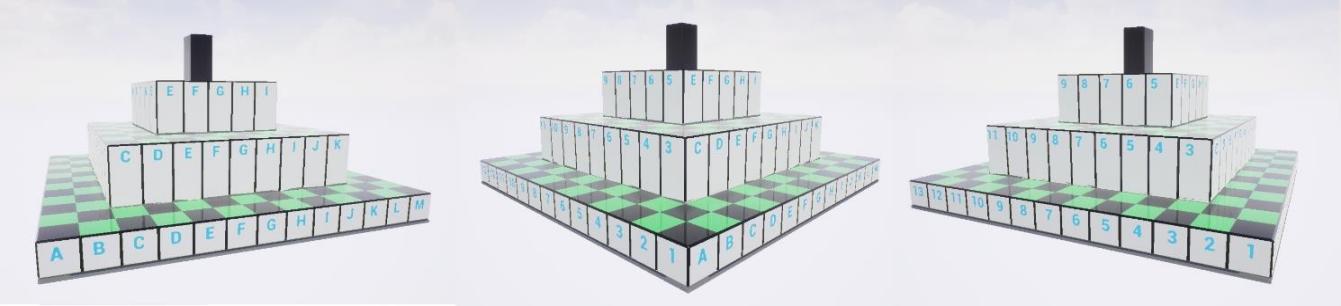
The first floor has 88 squares, the second has 56 squares, the third has 24 squares, and the last and fourth floor has a single square, the summit square, which can only be reached by the special block. The sum of all the squares per floor gives a total of 169, which is as if the board were viewed from a top-down perspective.
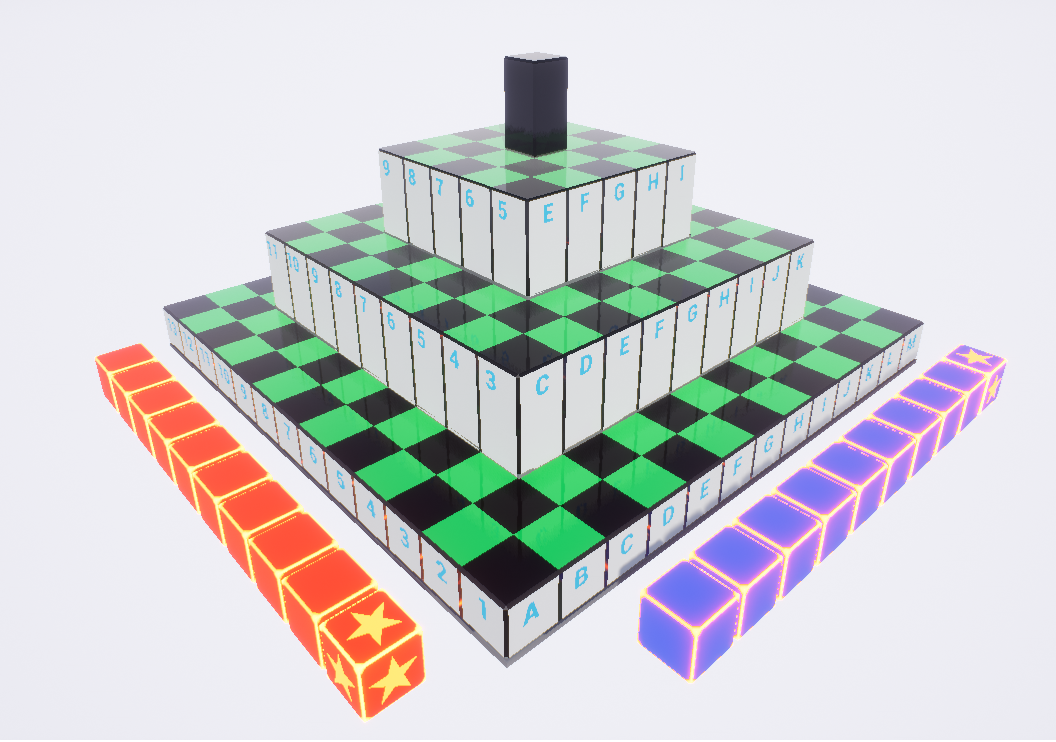
The XIMA board has several symmetries:
- Rotational symmetry about the Z-axis when rotated by 90, 180, 270, or 360 degrees around a central axis passing through the center of the board (Z-axis).
- Bilateral symmetry with respect to the XZ and YZ planes. Additionally, there are two more planes of bilateral symmetry, the planes formed along the diagonals that pass through the Z-axis.
If we simplify the symmetry, we are left with one-eighth of the board. This is important because when studying XIMA openings, all openings made in this section of the board are repeated in other parts of the board since it is symmetrical, thus defining them as unique and independent openings from the rest of the board.
Notation System in XIMA
Although there are 3 directions of movement on the Xima board, the notation system for Xima games is two-dimensional.
The notation system used in Xima is derived from an adaptation of the system used in Chess, which is called simplified algebraic. However, in Xima, we call it very simplified algebraic. This is because Xima has only one type of block, whereas Chess uses 6 pieces, which makes it unnecessary to highlight the name of the blocks unless referring to the special block, which will be denoted by an equal sign (=).
Another difference is that the boards, instead of having lowercase letters, in Xima the horizontals and verticals are defined with uppercase letters, as they will not interfere with the name of any block.
The very simplified algebraic notation system has two modes: the long or complete mode, which is easier for beginners to learn, where you only need to write the name of the square the block comes from, followed by the name of the square the block reaches. However, once players acquire skills in Xima, it is more practical and simplified to learn the short or abbreviated mode, which is less tedious to write and is also easy to understand. Below, we will provide an example of both modes. Unlike the long mode, the short mode is characterized by mentioning only the square where the block arrives, without having to specify from which square it leaves most of the time. Below are the steps for recording the moves in both cases.
- a) The move number followed by a period.
- b) The name of the destination square of the block being moved.(In the long mode, the starting square is noted first, followed by the destination square).
Note: If a new block is added to the board, a dash or minus sign (-) should be placed before the move, and if it is the special block, an equal sign (=) should be used to differentiate it.
Next, an example game is shown to compare the long and short notation systems.
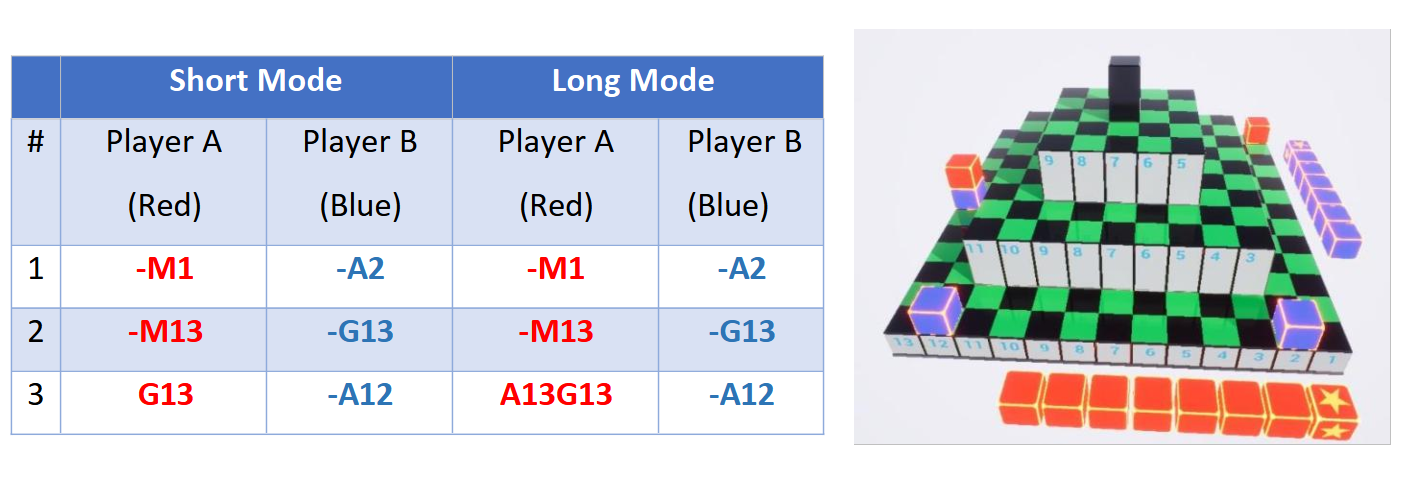
Notice how there is no need to put a minus sign in move 3 for the blue blocks because it moved one of the blocks already on the board, and also how in the long system, although it is very similar to the short one, it starts to become more extended in its writing from this point onward.
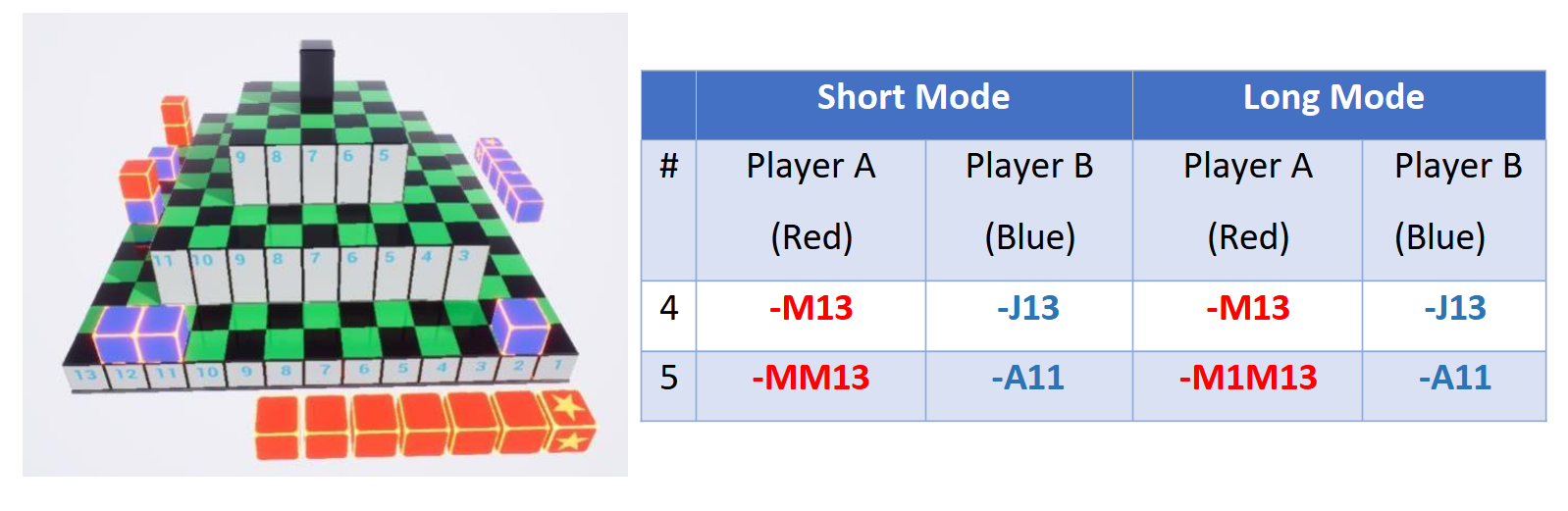
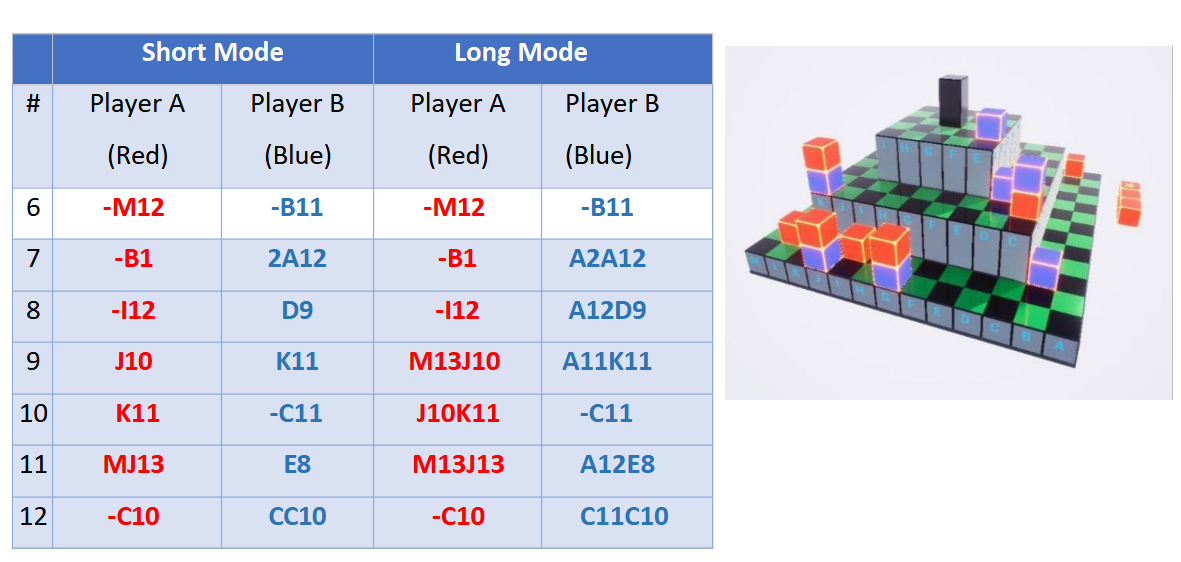
Pay attention to how in move 5 for the red blocks, there are two blocks that can move to the same square, M13, so you have to specify the column where the moving block is located, followed by the destination square. Now, if by chance there were two blocks from the same column moving to the same square, then the row should be specified, and if by some coincidence, there are two blocks in the same column and two in the same row, then it should be written just like the long mode, specifying both the starting and destination squares, and that's it. But be careful, this is not very common and are just sporadic situations that can arise, and I explain them here to clear up any future doubts.

As you can see, an (x) can be used to highlight a capture if desired, and it is very useful when evaluating the game.
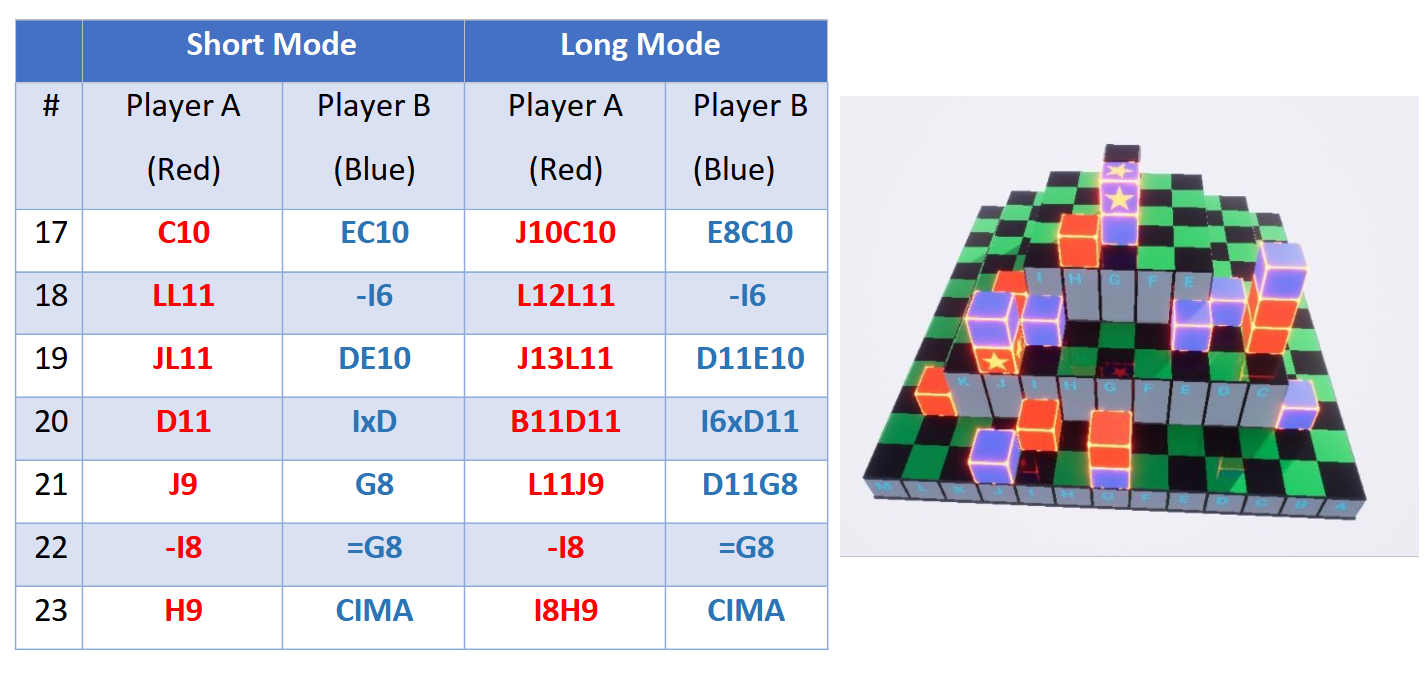
As you can see, the short mode remains the same as the game develops, which is why it is recommended for professionals, tournaments, and competitions. In contrast, the long mode requires more writing to convey the same thing, but its advantage is that it is easier to understand, which is why it is recommended for beginners.