History of the Xima Game
Xima was created in Cuba in 2010 by Yosdel Vicente Muiño Acevedo and Liz Power Suarez. It arose from a promise of love made by the game's creator to his girlfriend, the co-author of the game. Its goal was to gift her a new noble and completely peaceful game-science, different from the ones known until then. After several designs that ended in failure and others still under development, such as: El Ajetreo, 360 Grados, and 3Dmino, which were the predecessors, the foundations of Xima were developed.
Initially, the game was played at the authors' house with family and some local friends, and in a short time, it gained great acceptance. The same players recommended expanding it to another social sphere, so the decision was made to bring it to universities. At that time, Xima was played recreationally, with luck involved through a die, and it was not until 2018 that it took on a sporting character by eliminating the element of chance, turning it into a mental sport with equal conditions for all players.
In October 2016, the first official Xima tournament was held in its recreational mode at the Faculty of Electrical Engineering at the José Antonio Echeverría Technological University of Havana, CUJAE. In March 2017, as part of the "March 13" university games, about 400 students participated at the main venue. In 2019, the first community project of Xima was created in the Párraga locality, in the municipality of Arroyo Naranjo, Havana, Cuba.
The presentation of the game-science Xima participated and won its first Significant Award at the Ramal Sports Forum in Havana in June 2019. The first official public exhibition of Xima was in July during the Havana Fair 2019 at Expocuba, alongside the Provincial Directorate of Sports. It was repeated in October at the same venue, but this time at the Havana International Fair (FIHAV). In this event, Xima was recognized by the invited entrepreneurs as the game representing Havana in its 500th anniversary. In September 2019, a technical and methodological decree was approved, endorsed by the National Institute of Sports, Physical Education, and Recreation (INDER), the Ministry of Education (MINED), and the Institute of Science, Technology, and the Environment (CITMA), recognizing it as a game-science.
In 2020, Xima is undergoing a process of expansion and development. Currently, it is part of the teaching process at the A+ Adolescents Spaces Center of the Havana Historian's Office, in collaboration with UNICEF, as one of the workshops constituting its educational plan. Furthermore, as a demonstration of its ability to interrelate with other science games, Xima participates in the "Ajedrez Habana" project, a chess academy guided by three Cuban grandmasters.
Board Games
A board game is one that, as its name suggests, is played on a board or flat surface. The rules of the game depend on the type of game, and it can be played by one or more players. Some games require manual dexterity or logical reasoning, while others are based on chance. Throughout history, board games have represented one of humanity's oldest recreational activities, being used in various cultures as a means of education, entertainment, and, in some cases, conflict resolution or strategic training.
Board games come in a wide variety of types and can be classified according to their gameplay mechanics. Some of the most common types include:
- Strategy games: These games require a high degree of logical reasoning and planning. Players must make strategic decisions throughout the game. Examples of this type include:
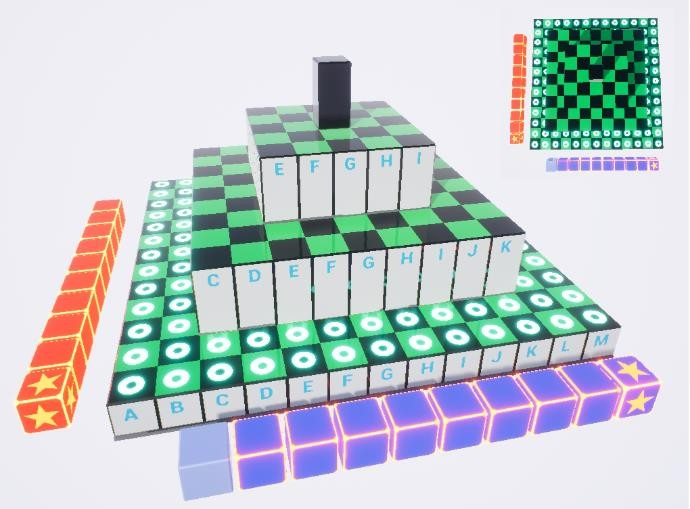
- Xima: Three-Dimensional Science Game. Each player starts with 10 blocks, one of which is the special block. The objective of the game is to move the special block to the top. The player who accomplishes this first wins the game. Number of players: 2 to 4.
- Chess: A classic two-player game where the objective is to checkmate the opponent's king.
- Go: An ancient Chinese game that involves surrounding the opponent's stones with one's own to gain territory.
- Checkers: Similar to chess, but with simpler piece movements. The goal is to capture the opponent's pieces.
- Xima: Three-Dimensional Science Game. Each player starts with 10 blocks, one of which is the special block. The objective of the game is to move the special block to the top. The player who accomplishes this first wins the game. Number of players: 2 to 4.
- Games of chance: In these games, luck plays a predominant role. Examples of this type include:
- Monopoly: An economic game where players buy properties and try to earn the most profit.
- Parcheesi: A board game that involves rolling dice and moving pieces to advance on the board.
- Lottery: A game of chance where players hope that their numbers are randomly selected to win.
- Card games: These are games played with a deck of cards. They may involve elements of both chance and strategy. Examples include:
- Poker: A card game involving betting and played mainly with card combinations.
- Solitaire: A card game played alone, where the player organizes the cards according to a set of rules.
- Uno: A card game where players must match colors or numbers and use special cards to change the game.
- Family or recreational board games: These games are designed to be played by large groups of people and are focused on social entertainment. Examples include:
- Scrabble: A word game in which players form words using letter tiles.
- Catan: A strategy game where players colonize an island by collecting resources and trading with other players.
- Clue (or Cluedo): A mystery game where players must deduce who committed a crime, with what weapon, and in which room.
Throughout the centuries, board games have evolved, adapting to new generations and technologies, but they continue to be a popular form of recreation and socialization today. In addition to being an educational tool, board games foster skills such as critical thinking, decision-making, and problem-solving.
History of Board Games
The history of board games stretches back thousands of years, reflecting the diverse cultures, traditions, and innovations of human civilization. The earliest board games were not just forms of entertainment but also served as vehicles for teaching strategy, culture, and life lessons. Evidence suggests that the first known board games were played in the ancient civilizations of Mesopotamia, Egypt, and the Indus Valley.
Early Origins
The earliest known board game is believed to be the Royal Game of Ur, which dates back to around 2600 BCE in Mesopotamia. This game, found in the Royal Tombs of Ur, involved a form of racing game played with dice and pieces moving across a board. Other ancient games, like Senet, were discovered in Egypt, with some scholars suggesting that Senet had ritualistic and symbolic meanings tied to life after death. It is believed that this game was played by the elite and could have been used for divination or to symbolize the journey through the afterlife.
In India, the game of Chaturanga (circa 600 CE), a precursor to chess, was played on a board that resembled a modern chessboard. It is from this game that chess and other strategy games would evolve, influencing global game culture for centuries. The concept of Chaturanga was introduced to Persia, where it became Shatranj, and eventually, it spread to Europe via the Islamic world.
Games in the Classical World
The Greeks and Romans made significant contributions to the development of board games. The Greeks created games like Petteia and Kottabos, which involved strategic movement of pieces on boards. The Romans, for instance, played a game called Latrunculi, which involved strategy and tactics similar to modern-day chess. These games were often used to train soldiers in strategic thinking, emphasizing planning and foresight. Other games, like Tabula (a predecessor of backgammon), were enjoyed by both the elite and common people alike, and were played in the public baths and other social spaces.
Medieval and Renaissance Games
During the Medieval period, board games began to appear in Europe. One of the most well-known games, chess, evolved from Chaturanga and gained popularity in the Islamic world before being introduced to Europe by the Moors in the 9th century. Chess became a game for the noble classes and was also used as a training tool for strategic warfare. The game underwent significant changes in its rules in Europe, with the modern version of chess solidifying in the 15th century.
The game of backgammon, with its roots in ancient Mesopotamian games, also became widely popular across Europe during this period. It was often played in taverns and royal courts, symbolizing both chance and skill. Another medieval game, The Game of the Goose, a race-type board game, originated in Italy and became a popular pastime across Europe.
In the Renaissance, there was a resurgence of interest in games as a form of intellectual and social entertainment. The development of card games, such as tarot and playing cards, also began during this time. These games evolved into an important part of European culture, and many medieval and Renaissance games are still played today, albeit with modern variations.
Modern Board Games
The 19th century saw the industrial revolution play a pivotal role in the mass production of board games, making them accessible to a broader public. The creation of games like Monopoly in the early 20th century marked the beginning of modern board gaming. These games introduced new themes and mechanics, such as property trading and economic simulation, which are still prevalent in today’s games. Monopoly, for example, was invented in 1903 by Elizabeth Magie as a way to demonstrate the negative aspects of monopolies and capitalistic greed, though it later evolved into a game of capitalist competition.
During the early 20th century, the development of abstract strategy games, such as Go, checkers, and various variations of chess, flourished. These games were widely popular in both Europe and Asia, with Go gaining particular importance in China, Japan, and Korea. The game of Go, originating from ancient China, is one of the oldest board games still played today and has a rich history of philosophical and strategic significance.
In the 1960s and 1970s, the emergence of the board game hobbyist movement led to the creation of modern board games like Risk, Clue, and Settlers of Catan. These games introduced more complex rules, social interaction, and player-driven strategies. The rise of modern board role-playing games (RPGs), such as Dungeons & Dragons, also expanded the boundaries of board gaming, incorporating elements of storytelling, fantasy, and imagination.
Digitalization and Modern Developments
The digital age has had a profound impact on the world of board games. The advent of video games, computer simulations, and online gaming platforms has led to the digital adaptation of traditional board games. Many classic games, like chess, backgammon, and Monopoly, now have digital versions that can be played on various devices.
In recent years, hybrid board games have emerged, blending physical board play with digital technology. These games often use apps or interactive features to enhance gameplay, making them more immersive and engaging. The rise of crowdfunding platforms like Kickstarter has also democratized the development of new games, allowing independent creators to produce innovative games that might otherwise have been overlooked by traditional publishers.
The board game industry has also seen a rise in niche games, with genres like strategy, deck-building, cooperative, and legacy games becoming increasingly popular. These games offer more complex mechanics, deeper themes, and a greater variety of player experiences, attracting a diverse and passionate community of gamers.
The history of board games reveals how they have been woven into the cultural fabric of societies around the world, often carrying meaning beyond just play. From the ancient games of strategy to modern recreational games, board games continue to evolve and inspire new generations of players. The development of these games has mirrored human progress, reflecting shifts in technology, culture, and the way we view competition and cooperation. Board games will undoubtedly continue to evolve, shaping and reflecting the cultures of future generations.
For further readings on the history and evolution of board games, refer to the works of Bell [Bell1979], Stern [Stern2014], Parlett [Parlett1999], and Zimmerman [Zimmerman2015], who provide in-depth discussions on the origins, development, and impact of these games on societies.
Classification of Board Games
Board games are commonly grouped into categories, each with particular features that differentiate them. Some of these are:
- Dice Games: These games use dice. Examples: Ludo, Backgammon, among others.
- Token Games: These involve the use of marked tokens. Examples: Dominoes, Mahjong.
- Card Games: Cards made from cardboard are decorated and printed with various designs, shapes, colors, and numbers. They have been used since ancient times for games and are called cards, decks, or playing cards. There are several types of playing cards or board games, with the most common being Spanish, French, or the unique Egyptian cards. Nowadays, card games are very popular as games of chance, with many varieties and countless ways to play them, such as Poker, Canasta, or Truco.
- Role-Playing Games: These are considered an experience with tools for imaginative development, skill development, and a wealth of supporting materials. They increase socialization between different people, genders, and ages, and they offer an active learning experience. Role-playing games involve trial and error, and players learn experientially. The themes of role-playing games vary, including medieval, warriors, pirates, gladiators, extraterrestrials, vikings, independence wars, fantasy, zombie horror, futuristic, and others, where costumes and weapons play an important role.
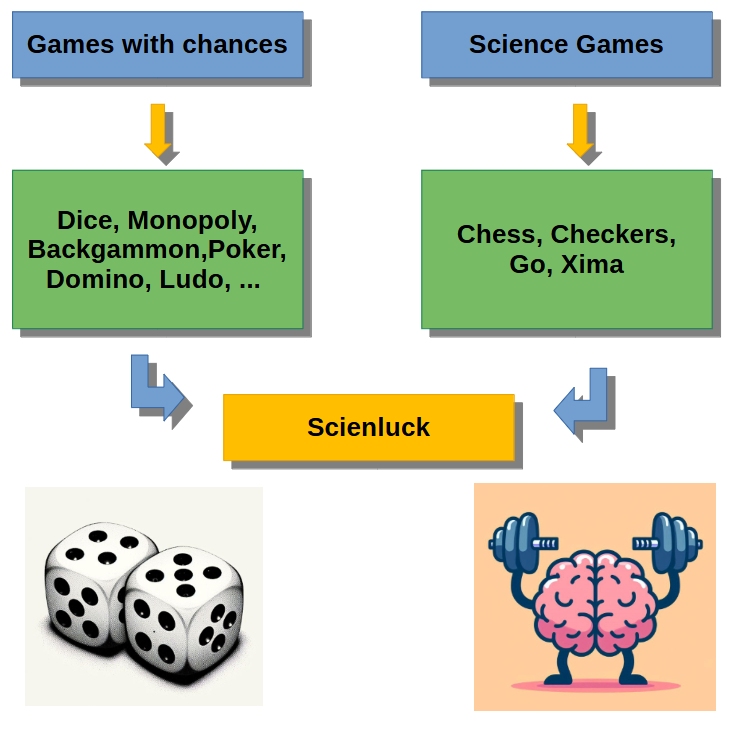
- Science Games: These are games understood as art, where winning depends not on luck, but on the player's skill and creativity. These games are considered sports. Examples: Chess, Checkers, Go, Xima, etc.
All existing board games can be classified in two ways: as games of chance and games that do not depend on chance to win. Games of chance rely on luck for victory, and are typically played for fun, with predicting exact results being impossible. On the other hand, games that do not involve chance can be considered sports because their outcome depends entirely on the player's skill and creativity.
The game Xima, however, cannot be classified into either of these two categories. Xima can be played with or without luck, and even with a combination of both in a single game. The first mode, with luck, involves dice. Both players roll a die to determine the number of available moves for their blocks. The second mode, without luck, is played in turns, with no movement limits for a block in a turn, and this is the competitive version that fits into science games.
In the third mode, one player uses two dice while the other plays in the competitive mode. The player who rolls the dice has the option to move two different blocks during their turn, while the other player can only move one block per turn, but with no movement limits for that block. This is a new mode called Scienluck, and it is unique to board games.
This new mode allows one player to use dice while the other does not, combining luck with strategic skill, making it both fun and engaging.
Number of Combinations
In this section, a summary of the number of possible combinations generated in the first turns of the games Checkers, Chess, Go, and Xima will be presented, along with a comparison between them.
First, let's define what we mean by the number of possible combinations. Suppose we have a 6-sided die and roll it. How many different possible outcomes do we have? The answer is evident: there are 6 possible combinations, as the die has 6 sides.
Now, suppose we have two 6-sided dice. How many possible combinations can occur? We would need to list the results: 1-1, 1-2, 1-3, 1-4, 1-5, 1-6, 2-1, 2-2, ..., 6-4, 6-5, and 6-6, totaling 36. However, some combinations are the same, such as 1-2 and 2-1, 3-4 and 4-3, and so on. Thus, while there are 36 possible combinations, there are only 18 unique combinations.
Applying this to board games for two players, let turn 1 of player 1 be denoted as \(T_1^1\) and turn 1 of player 2 as \(T_1^2\), turn 2 of player 1 as \(T_2^1\), and so on. Let \(C_{cp}\) represent the number of possible unique combinations at turn \(T_n\). The number of possible combinations \(C_{cp}\) of a game can be calculated using the expression:
where \(T\) is the number of turns up to which the number of combinations is to be calculated.
Combinations in the Game of Checkers
Let's calculate the number of combinations up to turn 2 for the game of Checkers.
In the first turn of the white player, \(T_1^1\), the number of possible combinations is 7. The 3 white checkers on the left can move to two squares on their diagonals, but the checker on H3 can only move to its left diagonal. Similarly, for the black player, there are 7 combinations regardless of what the white player does on their turn. center
center Suppose the white player moves D3E4 and the black player moves E6D5; then, on the second turn of the white player, due to the obstructions, 7 possible moves are available. The 5 checkers in front can only make one move, except for the checker on B3, which can make two moves.
Suppose the white player moves H3G4; now, let's look at the second turn of the black player and their possible moves. 5 checkers can move to one square, and one checker can move two squares, resulting in 7 possible moves in total.
Now we can calculate the number of possible combinations up to the second turn in the game of Checkers using the equation:
In the game of Checkers, by the second turn, there can be up to 2400 possible combinations.
Combinations in Chess
Let's calculate the number of combinations up to turn 2 for the game of Chess.
In the first turn, the white player can choose from 20 possible moves for the opening:
- 16 moves with the pawns (8 on the third row of the board and 8 on the fourth row).
- 4 moves with the knights (on squares A3, C3 with the queen's knight, and F3, H3 with the king's knight).
Additionally, the possibility of resigning should be considered, but it is only added in the turn where the calculation is made, as there is no point in counting the possibility of resigning and continuing the calculation. So, in the first turn of the chess game, the number of possible different moves is:
Suppose the white player moved a pawn to e4, as this position, along with e3, d3, and d4, are the moves that generate the most possible combinations in the next turn. What we want to calculate is an estimate of the number of possible moves, so we will maximize the moves that generate the maximum number of possible combinations.
Next, the black player, in the first turn, has the same number of possible moves since the board is symmetric:
And assuming the black player moved to e6. Now, for the second turn of the game, let's see what moves the white player can make:
- 14 moves from the 7 remaining pawns on the third row.
- 1 move from the pawn on e4.
- 4 moves from the knights.
- 1 move of the king to e2.
- 4 moves of the queen on the right diagonal (e2, f3, g4, and h5).
- 5 moves of the bishop on the left diagonal (e2, d3, c4, b5, and a6).
For the black player on their second turn, they will also have the same number of combinations as the white player, with the addition of the possibility of resigning.
Now we can calculate the number of combinations for turn 2 in the game of Chess:
This gives a total of more than 300 000 possible moves by the second turn.
Combinations in Go
Now let's calculate the number of combinations up to turn 2 for the game of Go on a board of dimensions \(D \times D\) (with \(D = 13\)). This calculation is simple with a basic analysis. In the first turns, both players can only place one stone, and there is a possibility of capture on the second turn of player B if player A places a stone in one of the four corners of the board and player B manages to surround it. However, this situation rarely occurs, although it cannot be completely ruled out.
Assuming that the game progresses without captures until turn \(T\), the number of possible combinations decreases by one each time as the board spaces are occupied. Player A, on their first turn, can place a stone in any of the \(D \times D = 169\) available spaces. Once player A places a stone, only 168 spaces remain for player B on their first turn, and after player B places their stone, player A has 167 spaces available to place a stone, and so on. This sequence continues until a capture occurs, freeing up spaces.
Taking this analysis into account, we can calculate the number of possible combinations up to the second turn:
With a total of over 700 million possible combinations just by the second turn, this is a massive number compared to the games of Chess and Checkers, mainly due to the large size of the board.
Combinations in the Game of XIMA
Let's consider the case of XIMA. There are 88 possible moves on the first floor for placing a common block and 88 for the special block. In the case of chess, there are 20 possible moves (16 with pawns and 4 with knights). Additionally, we must account for the possibility of resignation, but this is only added on the turn up to which the calculation is to be made, as it does not make sense to include the possibility of resignation and continue the calculation. For the first turn of the game, XIMA has a total of 176 possible move combinations, while chess has 20.
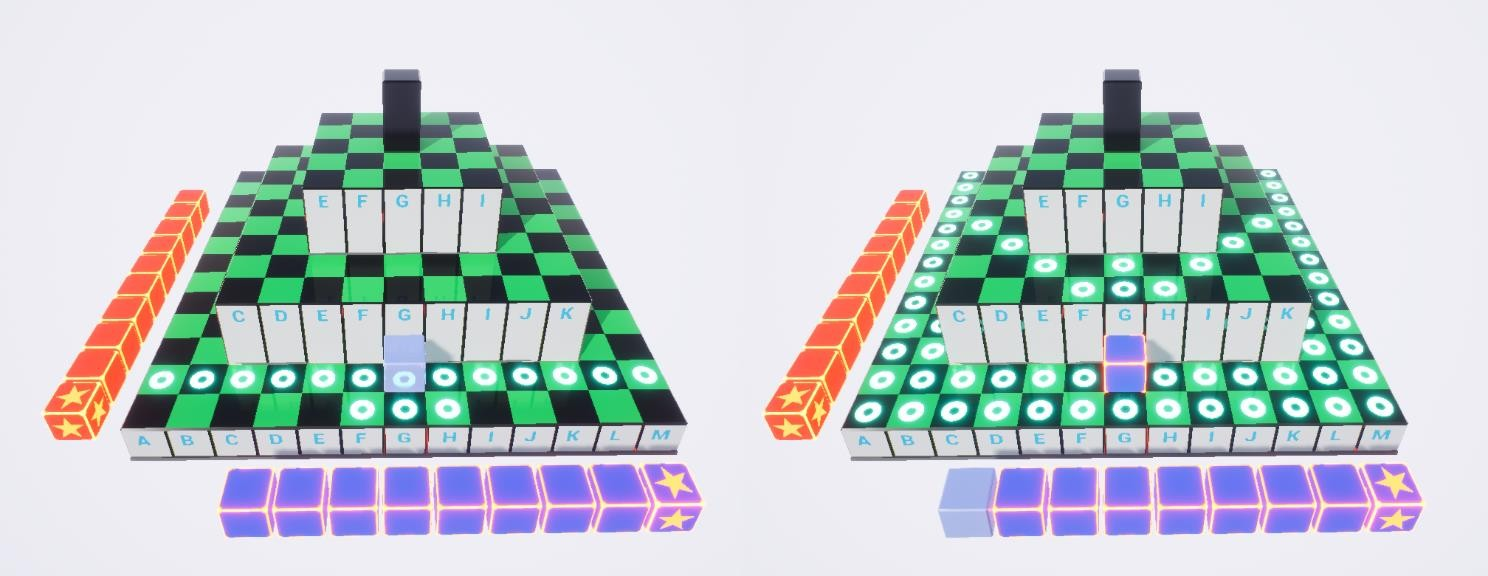
Now, assuming that player 1 made a move from the 176 possible ones (and did not resign), let’s assume that they placed a common block at position G2, as this position, along with B7, L7, and G11, are the ones that generate the most possible combinations. The goal here is to estimate the number of possible combinations in the game of XIMA, so we will maximize the moves that generate the most combinations.
Player 2 (red) on their first turn has access to the second floor and can also place a common or special block in 87 positions on the second floor, as one space is occupied by the blue common block at G7. On the second floor, player 2 can place a block in 10 more positions, but they can do so with either a common or special block, so there are 20 possible combinations. Adding these 174 placements on the first floor, the total number of possible combinations for player 2’s first turn is 194.
Now, multiplying the number of combinations for the blue player’s first turn by the number of combinations for the red player’s first turn gives the total number of possible combinations for the first turn.
Thus, there are 34,144 possible combinations for the first turn in the game of XIMA, while in chess, there are only 400 possible combinations on the first turn. This is not an exact calculation, as if the blue player were to play in the outer ring of the first floor, the red player would not be able to move to the second floor, reducing the number of combinations. However, this calculation provides a sense of the order of magnitude.
Let’s now analyze the second turn of the game. Suppose player 2 (red) places a common block at G4. On the second turn, the blue player moves first. As we can see in the image:
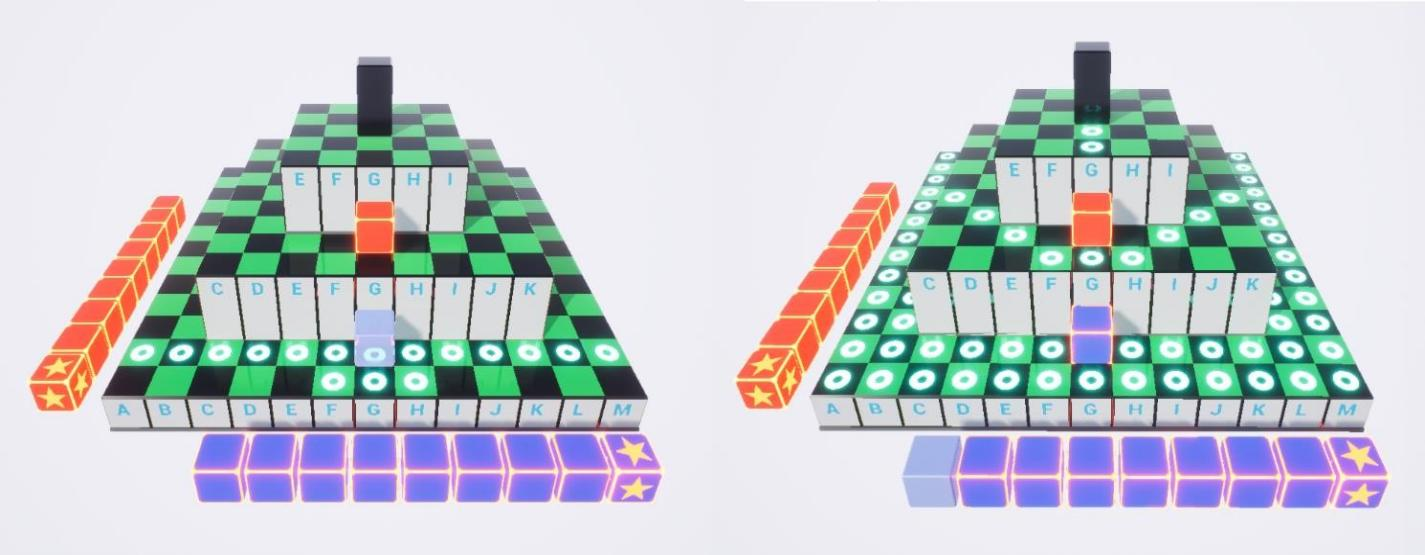
The blue player can move the block from G2 to 15 positions. They can place a common or special block in 87 positions on the first floor, in 9 positions on the second floor, and in 2 positions on the third floor. This results in a total of:
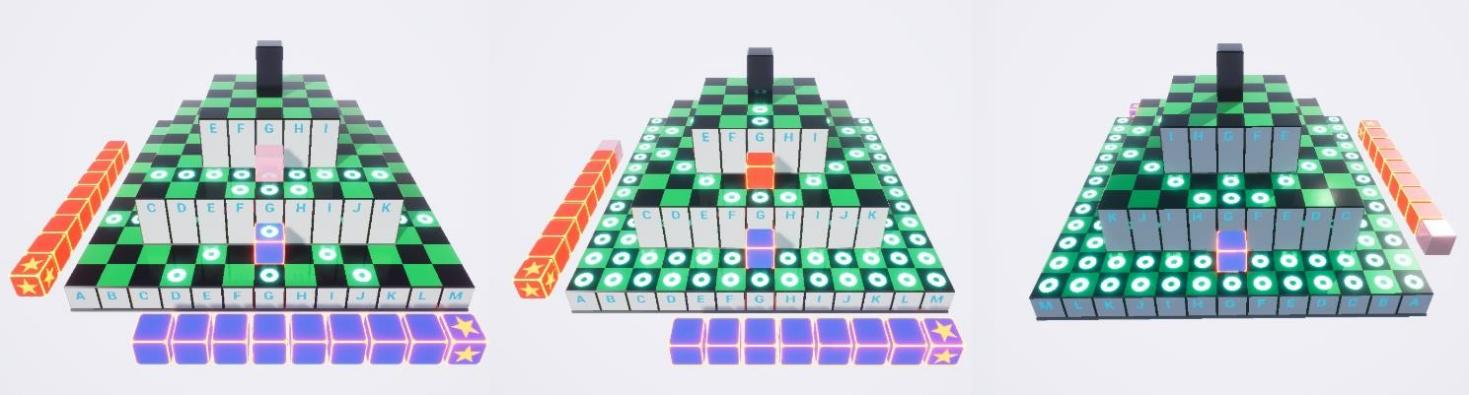
Now, assuming the blue player places a common block at G11 (other possible moves could be placing it at G6, L7, or B7, but G11 generates the most combinations). Now, it is red player’s turn, and they can move their common block from G4 to 21 positions. For placements on the first floor, there are 86 spaces for a common block and 86 for a special block. On the second floor, there are 9 for the step at G7 and 10 for the step at G11. On the third floor, there are only 2 positions, in addition to the possibility of resignation, as this is the point at which we want to end the calculation. The total number of possible combinations for player 2’s second turn is:
Now we can calculate the total number of combinations for the second turn in the XIMA game approximately:
Thus, the game of XIMA generates more than 1.7 billion combinations by the second turn, while chess has 348,000 possible combinations in its second turn, just half a million.

Note that the 19x19 Go game has more combinations than the Xima game with 2 players, both on the first turn and starting from the second turn. This is only for the case of 2 players, but Xima can be played with 3, 4, or even more players. In the case of the Xima game with 4 players, the combinations just on its first turn exceed those of 19x19 Go by 4 orders of magnitude, and for the second turn, the number of combinations is enormous, surpassing any existing board game, with more than two and a half quintillion combinations.