Magnitudes Describing the XIMA Game
Importance of Magnitudes in Board Games. The ELO Problem.
The habit of quantifying everything has been a necessity since the appearance of humans, leading to the origin of numbers. Even primitive humans could distinguish between two or more groups of objects without knowing how to count, because their instinct told them that it was better to accumulate a greater amount of food for the winter rather than a small amount. Although they couldn't count, they knew how much food they consumed daily and could differentiate between groups of elements. Numbers and arithmetic emerged as an evolutionary consequence for humans.
Today, everything is built on the basis of numbers and the magnitudes they describe. For any social, sports, political, economic, leisure, and many other activities, magnitudes are needed to describe the environment in which they are involved. To build a bridge, for instance, it is necessary to calculate the forces on the columns, tensions in the cables, the resistance of the beams, and other necessary magnitudes to ensure the structure is stable. The tendency to quantify things and describe them with magnitudes makes the world easier to understand.
The case of board games is no exception. Whether it's counting the points won or the number of steps to advance, numbers are used as a means of expression. Let’s consider a game like chess, where draws are possible. It’s very common to see a chess match end in a draw. If one were to ask, "Which player played better?" The answer would be that it was a draw, because it was a game that ended in a draw.
Let’s look at this example. Suppose we have 4 non-professional chess players (their ELO is unknown), and a tournament is organized with these 4 players in an elimination format. Player A plays against C, and B plays against D. As a result, players C and B win their respective matches. Now, if one were to ask, "Which player played better?" Both had different matches, but both won.
Does this mean they are at the same level? No, assuming they made no rookie mistakes during their games, one could not precisely know which player between B and C played better. This would also happen if the game were checkers, backgammon, Go, etc. There is no magnitude that qualifies the player based on their performance in the game. The way to measure if one player is better than another is by using their ranking (in the case of chess, this would be the ELO). There is no magnitude that characterizes chess players by their actions in the game, but rather a ranking that depends mainly on whether they win, draw, or lose the game, regardless of whether a game was good, average, poor, or spectacular.
ELO depends only on whether a player wins (1 point), draws (0.5 points), or loses (0 points), and on the previous ELO of the players. After the game, their ELO is adjusted using a logistic function based on each player's expected values. The ELO equation does not consider what happened in the game, just the results. Therefore, it is incapable of measuring the "force" of a player in the game, but instead relies on accumulating points from past victories.
Let’s look at the following example. Suppose a grandmaster with an ELO of 2560 points has 8 months to prepare for an important international tournament, but during that time, the grandmaster spends the time vacationing, relaxing, and doing everything except studying chess. Then, on the day of the tournament, the grandmaster plays his first match with an ELO of 2560 against another player with an ELO of 2127 (who studied chess every day without rest, preparing intensively for the tournament) and is easily defeated by his opponent.
So, which player is better? In terms of ELO, the player who went on vacation is still considered better, but the reality is different. The game showed that their skills did not match their current ranking, as they were defeated by a player with a much lower ranking. Does this mean the other player who defeated them is better? One cannot say just because they won a game. There is no additional information that can be measured to draw further conclusions. This is why board games (mainly scientific games) need new magnitudes that measure a player's skill level, their relative force, statistics, and more. New magnitudes are needed to describe other parameters, such as a player's experience, the force or emotion of a game, which are new alternatives to describe board games and make them more entertaining and understandable to an amateur audience.
This is where XIMA comes in as a scientific game with a revolutionary magnitude system capable of measuring a player’s game force, power, emotion, and gaming experience.
Xima has a new scoring system called CIMAX, a mathematical method that incorporates variables accounting for the player’s progress and performance during the game, allowing the calculation of the relative skill of Xima players. In addition, there are dynamic magnitudes that are calculated during each turn, such as game force, power, and skill level, making the game very entertaining for the audience. CIMAX is to XIMA what ELO is to chess, but with the difference that it takes the player’s performance in the match into account to calculate their new ranking scores. In other words, it does not only consider the match result but also what was done during the match. These new magnitudes help better understand scientific games, especially when dealing with draws. Interesting conclusions can be drawn.
Returning to the previous example, where players B and C won a match against players D and A respectively, we can now know with some probability which player is better: B or C. If the tournament were XIMA, even without knowing the players' rankings, the magnitudes describing the game would help answer which player is better. In the game between player A and C, player A had a game force of 34 points, while player B had a game force of 56.5 points against D. It can be concluded that player B is likely better than C, even without knowing their rankings (in this case, referring to CIMAX), as the game force developed by player B in the first match is 1.6 times greater than that of player C, and it is highly probable that if players B and C play against each other, B will win.
But what exactly is game force, and how is it calculated? The following describes each of the magnitudes that define the XIMA game.
Game Force
The Game Force is a dynamic, measurable scalar quantity in the game Xima that provides the positional value of blocks, captured blocks, the potential of blocks outside the game, and other factors. A higher game force relative to the opposing player generally indicates better control over the board and a better position compared to the opponent. Game force is directly proportional to having greater control over the third level, dominating blocks, capturing blocks, having blocks outside the board to incorporate, and, of course, winning the game. The unit of measurement for game force is the Xima [Xima].
The game force \(F_G\) of a player is calculated as:
where:
- \(V_{BB}\) (Value of the blocks on the board): We explained how to calculate it in the next section.
- \(V_{OB}\) (Value of the blocks off the board): Once the first block is incorporated, the value of each block off the board equals the average value of the blocks on the board.
- \(V_{CB}\) (Value of the captured blocks): Before a block is captured, it always has a value in that position. When captured, it retains that last value, which is added as force points to the player who captured it.
- \(V_R\) (Resignation value): The player who resigns will give the opposing player half of their game force. If a player runs out of time, it is also considered a resignation.
- \(V_W\) (Win value): When the special block is positioned at the top, the game is automatically won, and a value of 16 XIMAs is added to the game force. Normally, a common block would generate 8 XIMAs, but remember that this one is special.
Value of the blocks on the board
A XIMA board has three floors where common blocks can be positioned. The value of a common block is \(2n\), where \(n = 1, 2, 3\) depending on the floor where the block is located, except for the special block, which is worth two blocks and can be positioned on the 4th floor if it reaches the top. The value of the special block is \(4n\), where \(n = 1, 2, 3, 4\).
Block Value on the Board for Different Positions

The common red block in position A1 is worth 2 points, being on the first floor. The common blue block in position C3 is worth 4 points, being on the second floor. The special blue block in C7 is worth 8 points as it is worth two common blocks on the second floor, and the special red block in F7 is worth 12 points on the third floor.
If a block is dominating another, its value on the board changes. The dominating block acquires half the points of the blocks it is dominating, and the dominated block is worth half its points. Example 1: Consider a common blue block dominated by a common red block on floor \(n\). The value of the dominating red block is \(2n + n = 3n\), and the value of the dominated blue block is \(2n - n = n\). Let \(p\) be the number of common blocks dominated by a common dominating block, then the value of the dominating block is \(2n + pn = (2 + p)n\).
Value of Dominated and Dominant Blocks
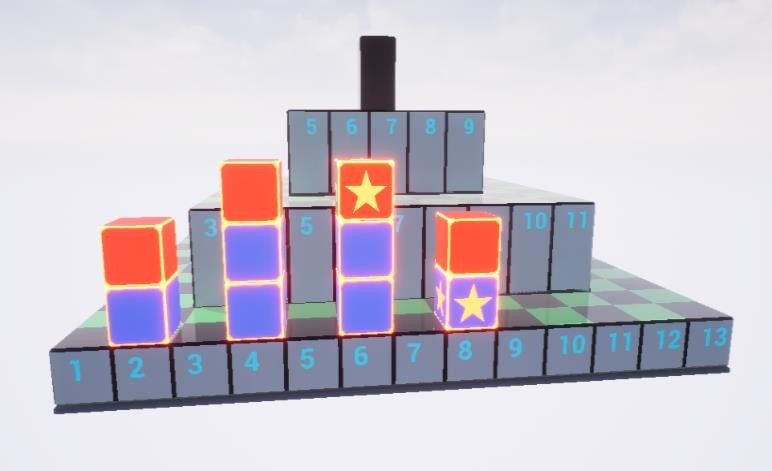
The red block 21 on A2 is worth 3 points, acquiring half the points from the blue block, which is worth 1 point when dominated. Note that the total value of the two blocks together is 4. The total value of the blocks is conserved but redistributed. In the case of the red block on A4, it is worth 4 points while dominating two blocks, and the dominated blocks are worth 1 point each.
If the special block is the dominating block on A6, its value is 6 points. Lastly, if the special block is the dominated block, as in A8, its value is 2 points because it loses half of its points.
Value of Dominated and Dominant Blocks on Different Levels
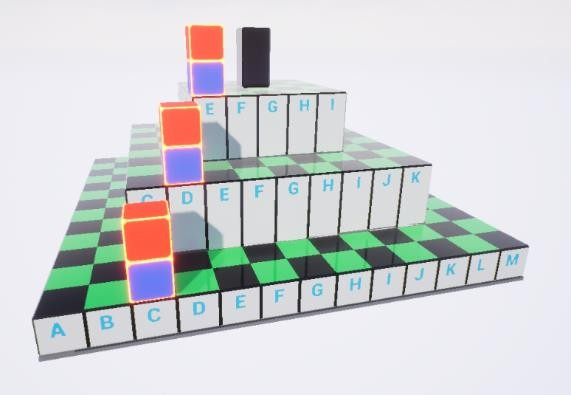
For the first level, we had already seen that the red block on C1 is worth 3 points, and the blue block is worth 1 point. On the second level, the red block on D3 is worth 6 points, and the blue block is worth 2 points. On the third level, in E5, the red block is worth 9 points, and the blue block is worth 3 points. As you move to a higher level, the dominating block gains 3 points, and the dominated block gains 1 point.
The value of the blocks that are associated with it is relative, as there are situations where different blocks may have the same positional value on the board but not the same functional value. This is evident since, while all blocks on the first floor, for example, have the same value of 2 points, they do not serve the same functions. Some blocks are more important because they may be threatening an important position or serving another function. This functional value is not considered when calculating the game force, as game force is calculated at the end of the game. Once the game ends, blocks no longer have a function. However, if the game force were to be calculated at each player's turn, the functional value of the blocks would not be taken into account. This is a topic that remains open for discussion in order to improve the scoring system.
Importance of Functional Value of the Blocks

In this situation, it can be observed that the two blue blocks on E1 and H2 have the same positional value of 2 points because they are on the first level. However, they serve different functions. The blue block on E1 can capture the enemy special block on its turn, making it much more important than the blue block on H2, which does not have a direct attacking function but serves as a stepping stone for the third floor. When comparing the importance of their functions, it is clear that capturing the enemy's special block forces the opponent to use more blocks to free it, while the blue blocks can use those turns to reach higher levels.

In this case, let’s analyze the functional value of the three red blocks on the second floor. The red block on E3 is about to block the advancement of the blue blocks if it moves to position C3, as the blue blocks would no longer be able to rise to the second floor. The red block on J4 can dominate the blue block on H4, and in its next turn, it will rise to the third floor, which increases the chances for the red blocks to reach the top. Meanwhile, the red block on D7 does not seem to serve any apparent function.
These three red blocks on the second floor have the same positional value but serve different functions. This is just a simple analysis of how complicated it can be in other cases, leading to the question: What is the best move? For which, there is no answer for now, as XIMA, like chess and other board games, is a sport that does not depend on chance. If the question could be answered in any of these games, they would no longer be sports games because it would not make sense to play something where knowing the best move would always guarantee a win or a draw, as in chess, because in XIMA, there are no draws.
Value of Blocks Outside the Board
Each block outside has a potential to act, a game force that has not been incorporated, a reserve of important material, and has its value and importance in the game. At the start of the XIMA game, when no blocks have been incorporated into the board, each block outside is worth 1 point. Once the first block is incorporated, the value of each block outside becomes a function of the value of the blocks on the board divided by the number of blocks on the board.
where \(N_T\) is the number of blocks inside the game board. It holds that \(N_T = N_{B}+N_{OB}\), where \(N_{OB}\) is the number of blocks outside the game board, and \(N_T\) is the total number of blocks for the player, which is not necessarily 10. If the blocks inside the board are captured, this number decreases. Additionally, if \(N = 0\), the player automatically loses the game because they have no blocks inside or outside the board. The value of each block outside the board \(V_{BB}/N_B\) is the same for all blocks, as it is indistinguishable which block to use when incorporating it, whether it is a common block or the special block.
Value of Blocks Outside the Board at the Start of the Game
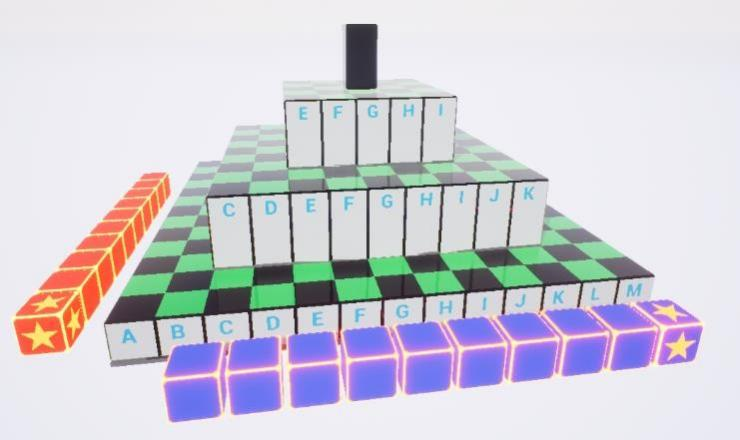
At the beginning of the game, each player has 9 common blocks and 1 special block. On turn zero, these blocks outside the board have a value of 1 point, including the special block. Since there are no blocks on the board, the blocks outside cannot be combined with the blocks on the board. They only serve the function of being incorporated, but this is only valid on turn zero. Once a block is incorporated on turn one, these blocks serve a more complex function and are no longer worth 1 point. The following illustration explains this.
Value of Blocks Outside the Board in Midgame
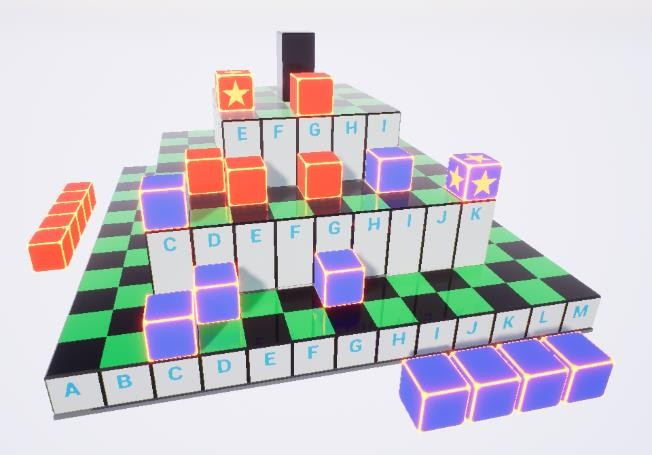
Let’s calculate the value of a block outside the board. First, the value of the red blocks inside the board is 30 points, and the value of the blue blocks is 22. The number of red blocks inside the board is 5, and the number of blue blocks is 6. We can see that the red blocks, despite having one less block than the blues, have more points, thus more game force. Calculating the value of a block outside the board, for the reds, it is \(\frac{30}{5} = 6\) points, while for the blues, it is \(\frac{22}{6} = 3.66\) points. A red block outside the board is worth more than a blue one because the red player has more control over the board with fewer blocks inside the board. In conclusion, the red player has a total value of blocks outside the board equal to 30 points, and the blue player has 14.66 points.
Value of Captured Blocks (\(V_{CB}\))
The process of capturing an enemy block requires the use of blocks and expenditure of turns. Once the block is captured, it is removed from the game with no possibility of returning (except in the case of the special block, see: rescue of the special). Its value on the board is transferred to the game force of the opponent as a reward for spending blocks and turns to capture that block. The value of the captured block varies depending on the floor it is on, the blocks it is dominating, and its positional value in the game. However, its value is only taken into account at the moment it is captured.
Block Capture Process

A block is captured when there is a majority of blocks of one color in a column relative to the other color, and the block at the top of the tower in that column is of the color that captures. For example, in square E1, the red block dominates the blue block, but it does not capture it because there is no majority of red blocks in that case. However, if the block in H1 moves to E1, the red block would be captured, as there is a majority of blue blocks in that column, and a blue block dominates the rest. This capture situation should not be confused with the case where a red block dominates two blue blocks, in which there is a majority of blue blocks, but the red block dominates at the top of the column, so there is no capture. The capture process has a value. In the case that the block in H1 captures the block in E1, it would gain 3 points, as the red block before the capture was worth 3 points for dominating a blue block.
Capture Value of Blocks
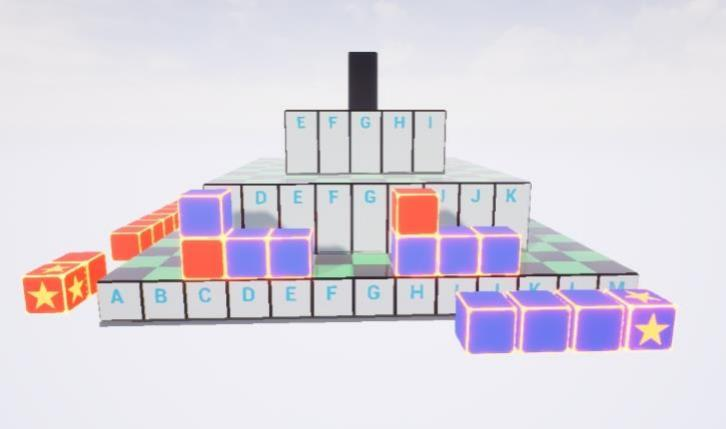
Let’s look at the following situation. Both are capture situations, but the point gain is different. In the first case, the blue block on E1 can capture at C1, and the red block is worth 1 point, which is the gain from the capture. In the second case, the blue block on J1 captures at H1 and absorbs 3 points, which is the value of the red block dominating the blue block in that case. Both are capture processes, but the gain is different, as the captured red blocks do not have the same positional or functional value. The red block at C1 is dominated by a blue block and is completely immobilized and without apparent functional value. The red block at H1, on the other hand, is the dominating block and can move freely to another position, so it remains a threat.
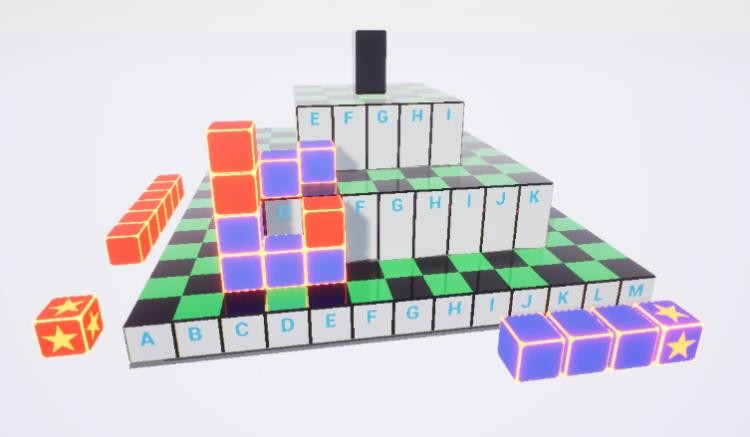
Let’s calculate the gain from capturing in the following case: the blue block at E4 can capture at C2 and E2. If the blue block captures at C1, it would eliminate two red blocks from the game. So, the smartest option, when capturing in that position, would absorb 6 points, as the red block on top is worth 4 points, and the red block beneath it is worth 2 points. In the case of capturing at E2, only 3 points would be gained, as the red block is worth 3 points. Clearly, the capture is an important transformation that must be done carefully, as sometimes the capture that generates more points may not be the most appropriate.
Resignation Value (\(V_R\))
The player has the right to surrender, or if the time runs out on the clock, it will also be considered a surrender. Surrendering directly affects the game force of the opponent, whether for strategic reasons or external causes. When a player surrenders, it prevents the opponent from increasing their game force. Therefore, the player who surrenders is penalized by distributing their game force equally among the other players.
where \(F_{G,O}\) is thr opponent's game force at the moment of surrender and \(N_P\) is the number of players.
In the case of two players, it is as follows:
Value for Reaching the Top
When the special block reaches the top, the game is automatically won, and a game force value of 16 ximas is acquired (the value of a common block on the 4th floor is 8 ximas, but since the special block is worth two common blocks, its value on the 4th floor is 16 ximas). Although this value should be infinite since reaching the top represents the highest achievement in life.
Calculation of Game Force
Once the Xima game ends, the game force value of both players is calculated. Let's look at an example of how to calculate this for a game.
Example Game:
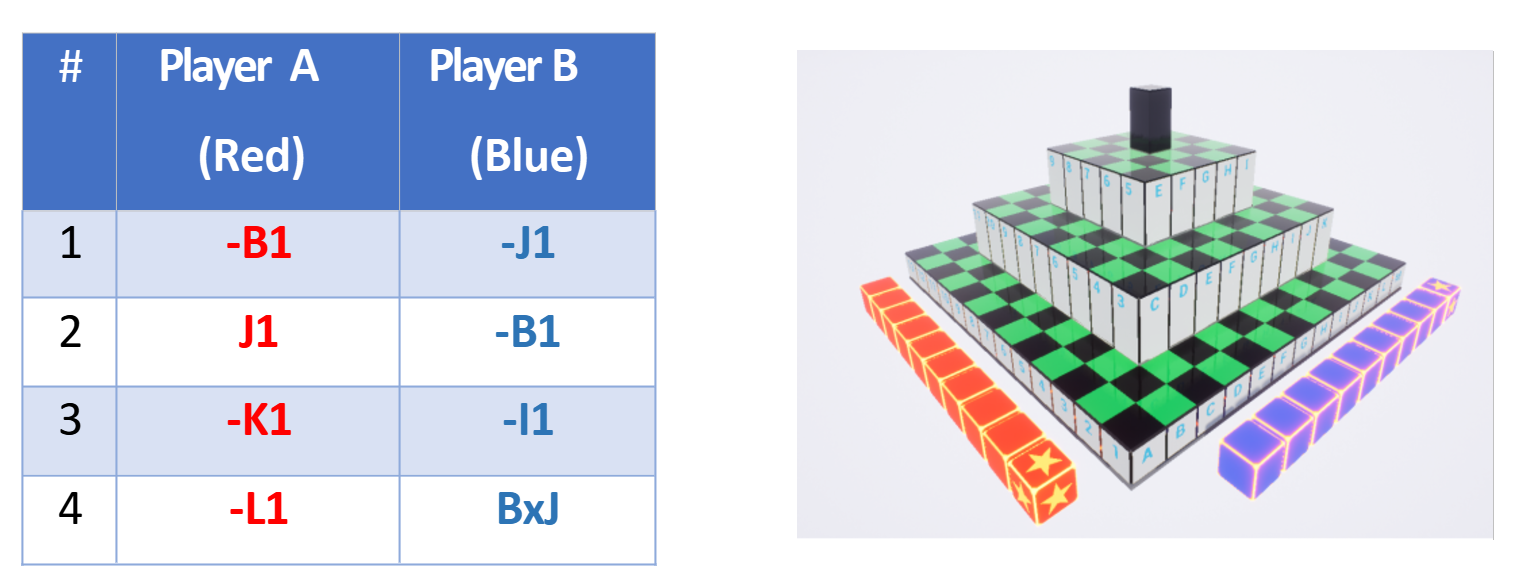
J1: Dominates from the beginning, although ideally, blocks should keep being incorporated, and not repeat moves with the same block.
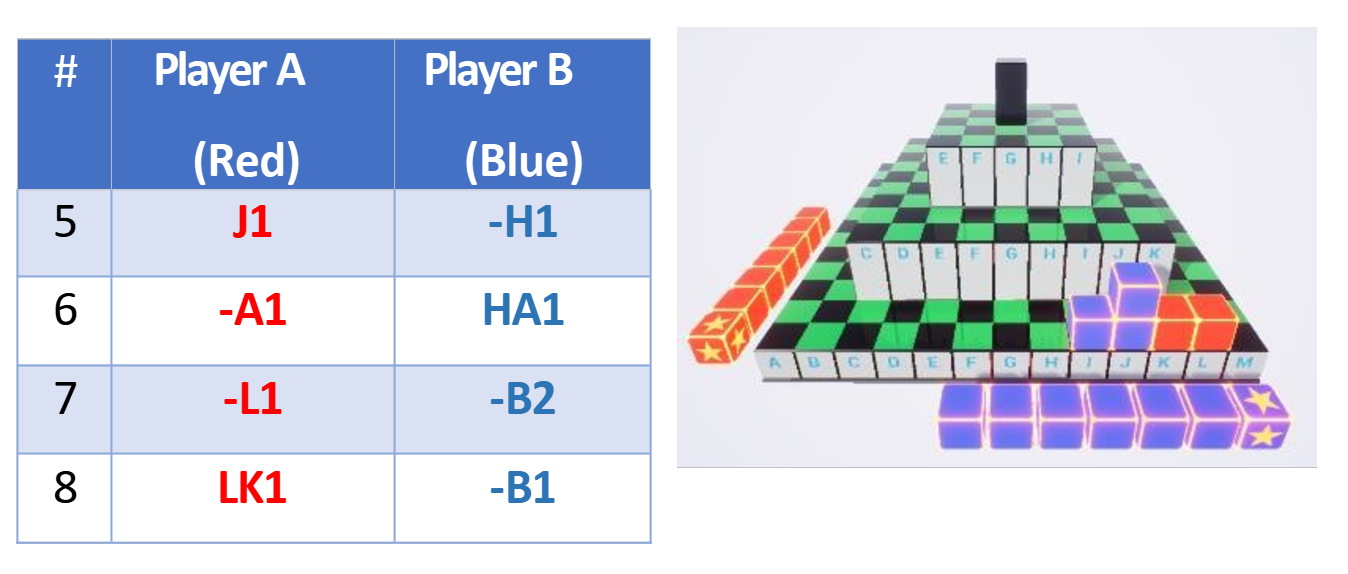
BxJ: Captures a red block in exchange for the blue blocks dominating J1 in the next turn. The red player loses a block and is forced to dominate at J1 to balance the lost block. The blue player now has two blocks captured, and the red player has one dominant block and one removed, a seemingly balanced situation, but the blue player may recover their blocks from J1 in the future.
HA1: Dominates at A1 with the goal of placing a step block at B2 and moving to the second floor. It's a bad move for the red player to incorporate at A1.
LK1: Doubles their blocks at K1, places a step, and moves quickly to the second floor, as the blue player is already entering it.
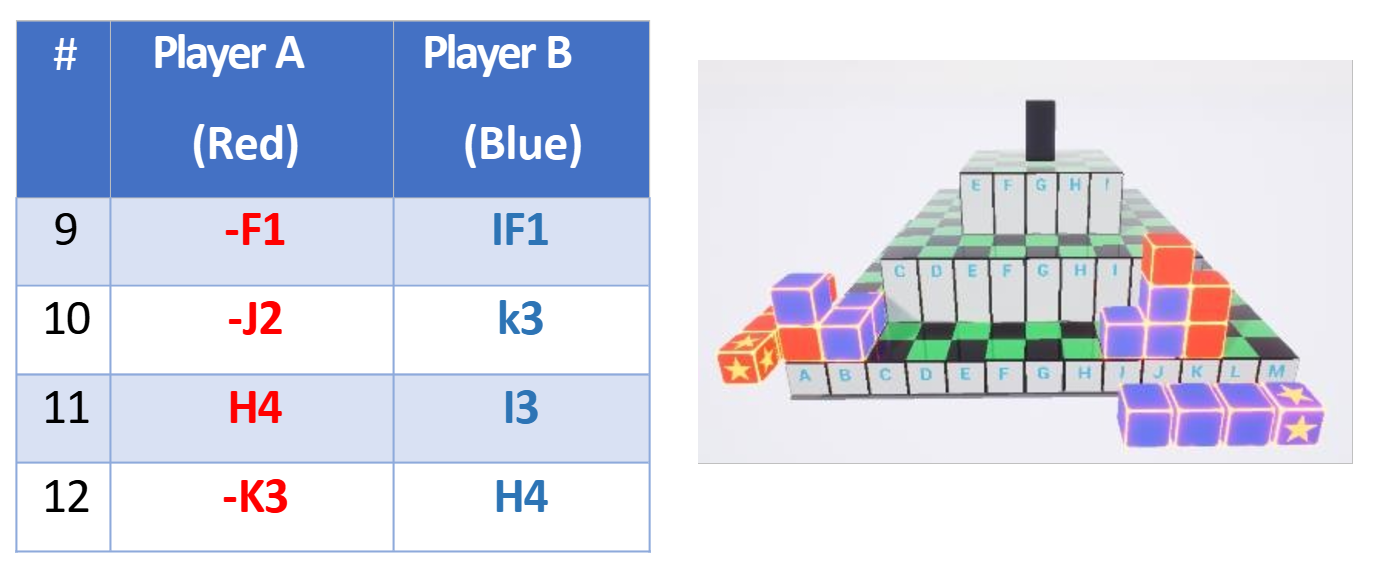
K3: Incorporates at K3 due to the red step block, leaving an opening to move to the 2nd floor.
-K3: The red player prefers to let the blue block access the 3rd floor to continue incorporating blocks to the 2nd floor and maintain a better position.

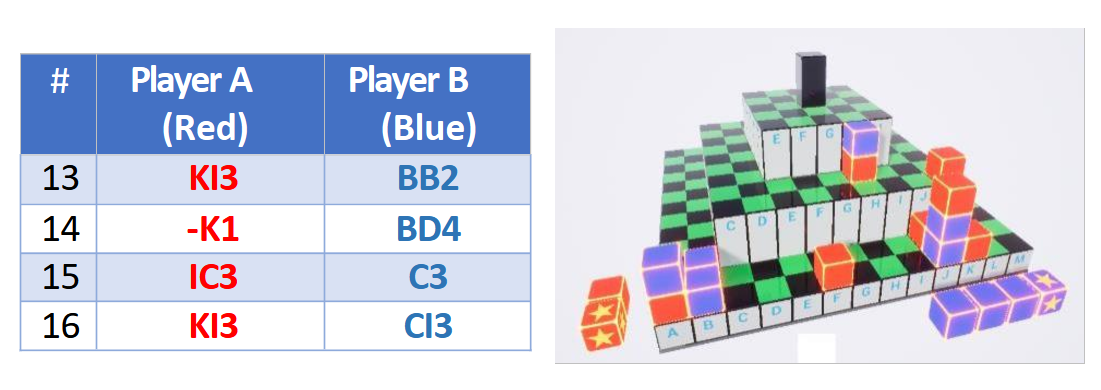
IC3: The red block at I3 is forced to block the blue ascent to the 2nd floor from A1.
CI3: The blue block dominating at C3 takes over the other block at I3, preventing communication between the red blocks at C3 and K3 and gaining access to the 3rd floor. However, they neglect the block at A1, which can now be captured by the red block at C3. If the red player captures at A1, they would just delay their blocks back to the 1st floor, while the blue player can remove their step at B2 to prevent it from returning to the 2nd level.
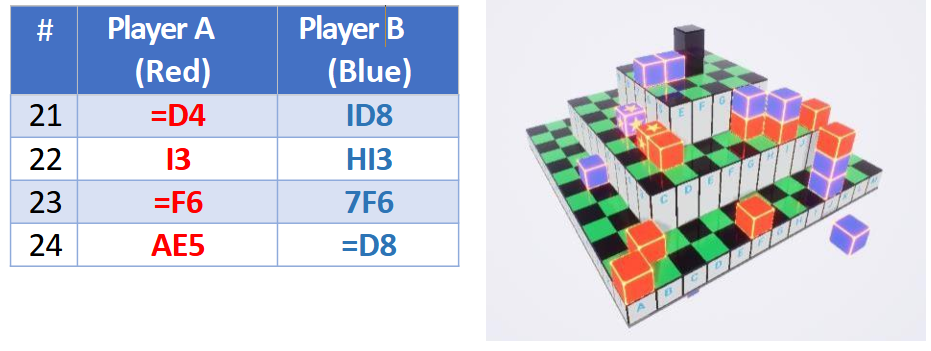
=D7: The incorporation of the special block at D7 as a step is a very good move because the red player has no blocks left on the board, allowing the blue player to easily move their reserve blocks to the 3rd floor.
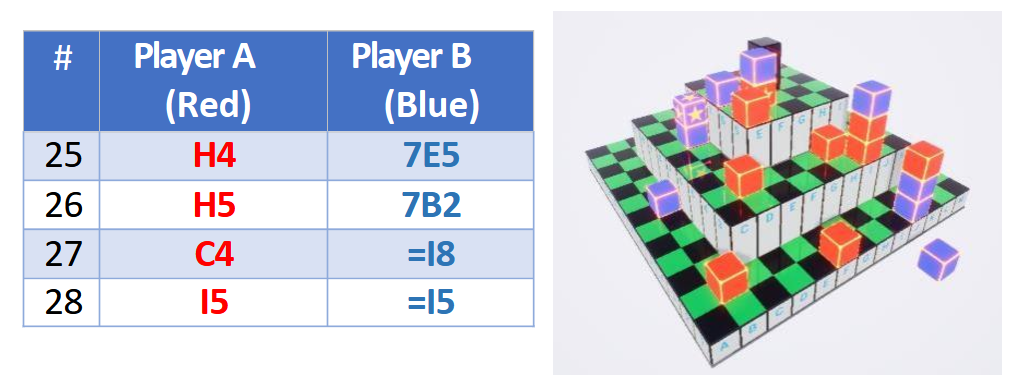
=F6: The red special block moves to a square where it can be dominated, as the blue player has complete control of the 3rd floor, and the red player sacrifices their special block in exchange for gaining time.
=I8: The blue special block moves to the 3rd floor.
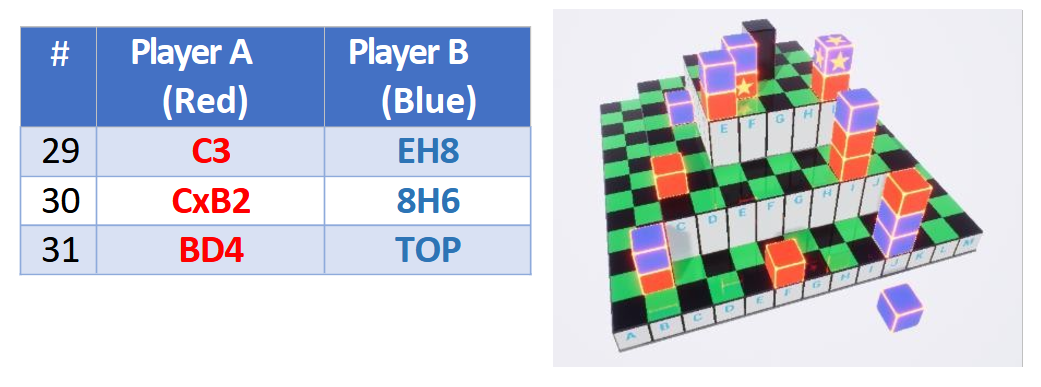
I5: The red player sacrifices their red block at I5 to be captured by the special block, as they have no better move. The blue blocks dominate all blocks on the 3rd floor, and the red player has no more material to incorporate nor any possibility to move blocks to the 3rd floor. The red player is losing the game
EH8: The blue block moves to H8 to then move to H6, allowing the special block to reach the top. The red player cannot stop this.
TOP: The blue special block reaches the top and wins the game.

Steps to Calculate the Game Force of a Player
Now let's calculate the game force. To do this, we present a series of steps to follow:
- Sum the value of all the blocks on the board for the player. This starts by counting the value of the blocks on the third floor down to the first floor. The sum of all these values gives the value of the blocks on the board .
- Count the number of blocks outside the board at the end of the game and the number of blocks inside the board for the player. Divide the value of the blocks on the board by the number of blocks inside the board and multiply it by the number of blocks outside the board, giving the result as the value of the blocks outside the board (\(V_{OB}\)).
- Count the value of the blocks captured during the game. This value should be noted at the time of capture or checked in the game notes as it is often forgotten. The sum of the points for capturing blocks is the value of the captured blocks (\(V_{CB}\)).
- In the case of a player's surrender (or if the clock runs out, which is also considered a surrender), the player who surrenders transfers half of the points from their blocks on the board to the winning player. The winning player must add half of the points from the surrendered player's blocks on the board. This value is called the surrender value (\(V_R\)).
- The winning player gains 16 points for winning; this value is called the winning value (\(V_W\)).
- Finally, sum all the accumulated points, which gives the value of the player's game force. The game force equation can be used, which contains the sum of each term.
Let's Apply These Steps to Calculate the Game Force of Each Player.

For the red player:
- Summing the points from all the red blocks gives a total of 34 ximas (\(V_{BB}=34\)).
- The red player incorporated all their blocks onto the board, so they have no blocks outside the board \(V_{OB}=0\).
- Two blue blocks were captured, one on the first floor worth 3 points and another on the first floor also worth 3 points, so \(V_{CB}=6\) .
- No player surrendered.
- The red player lost, so \(V_{W}=0\).
- Summing all the points gives a total of \(F_{G}=40\) ximas for the red player.
For the winning blue player:
- Summing the points from all the blue blocks gives a total of 27 ximas (\(V_{BB}=27\)).
- The blue player has one block outside the board \(N_{OB}=1\) and has 6 blocks inside the board (\(N_B=6\)), dividing \(V_{BB}\) by gives the value of the block outside \(V_{OB}=4.5\).
- One red block was captured, one on the first floor worth 3 points (\(V_{CB}=3\)).
- No player surrendered.
- The blue player won, so \(V_W=16\) ximas.
- Summing all the points gives a total of \(F_G=50.5\), a game force of 10 points more compared to the red player.
This game forces information tells us which player achieved greater domination on the board. A player with a high game force is likely to win the game since they have one or more blocks on the third floor, dominate more enemy blocks, and have had one or more captures. On the other hand, a player with a low game force means they have incorporated few blocks, had one or more blocks captured, and have few or no blocks on the third floor.
Game force is used to calculate the game power and, with this value, the CIMAX of each player, a concept that will be explained in the following chapters.
Game Power
Game Power: A dynamic quantitative scalar magnitude measurable in the Xima game that gives us an average of the game force per turns used. A higher game power compared to the opponent generally indicates that more game force was generated per turn and less time was used on the clock. Game power is directly proportional to game force, using less time on the clock, and winning the game in the fewest turns possible. The unit of measurement for game power is Xima per turn [Xima per turn].
The game power \(P\) of a player is calculated as:
where:
- \(T\) (turns taken by the player in the game): The average number of turns in a game is 30 turns, 10 turns for short games, and 50 turns for long games. There is no limit on the number of turns per player as long as the clock does not reach zero.
- \(t_e\) (Effective time): The effective time is the ratio of the time the player used to the total agreed time. For example, if both players agree to 10 minutes each, this would be the agreed time, and the time used until the game ends is the employed time, which is usually different for each player. In formula form, it would look like this:
This effective time gives us an idea of the time spent by the player. If \(t_e = 1\), the player loses the game because their time has run out.
Game power is directly proportional to game force and inversely proportional to the time on the clock and the number of turns taken by the player.
Let's analyze the limit cases of the game power equation. First, assuming an effective time factor of \(t_e = 0.1\), which means the player used 10% of the total agreed time, the player's power can be approximated as:
This indicates that "playing fast" (using the least possible time on the clock) increases the player's power. Now, secondly, if we assume an effective time factor of \(t_e = 0.9\), meaning the player used 90% of the total agreed time, the player's power can be approximated as:
This means that using most of the clock time is penalized with half the game force.
For an average XIMA game, an average player consumes 50% of the total agreed time (\(t_e = 0.5\)), uses about 30 turns (\(T = 30\)), and has a game force of 80 Ximas (\(F = 85 \text{Ximas}\)); their game power will be 2 Ximas per turn (\(P = 2 \text{Ximas/turn}\)), which means that on average, after the time penalty, an average player develops a game force of 2 Ximas per turn.
Having a higher game power induces a greater game force and increases the chances of victory. Let \(P_1\) be the game power of player 1 and \(P_2\) the game power of player 2. The condition \(P_1 < P_2\) does not guarantee victory for player 2 due to possible errors that player may make ("bad moves"), even having better control of the board, domination, availability of blocks, and therefore game force. Having greater game power than the opponent does not guarantee reaching the top, as game power is a measure of the average game force per turn that the player develops in a game of XIMA.
Steps to Calculate the Game Power of a Player
- Calculate the Game Force \(F_G\) previously, a value that is calculated using the steps indicated in the previous section.
- Note the time spent on the clock \(t_{\text{used}}\) (The time used is not the time shown on the clock; that is the elapsed time. To calculate the time used, subtract the elapsed time on the clock from the agreed total time.) and the number of turns taken \(T\) by the player.
- Calculate the effective time \(t_e\), as the division of the time used \(t_{used}\) by the total agreed time \(t_{agreed}\).
- For the calculation of game power, use the equation above potencia. First, divide the game force \(F_G\) by the number of turns \(T\). Second, calculate the power of 2 raised to the effective time, \(2^{t_e}\) (this calculation requires a scientific calculator). Third, divide the first term calculated by the second, giving the game power.
With the game data presented in the previous section, let's calculate the game power of each player. We know that the time spent is \(t_{used}(A) = 24.5\) minutes and \(t_{used}(B) = 16.1\) minutes out of a total agreed time of 60 minutes, and the number of turns is \(T = 31\) for both players.
For player A (Red):
- The previously calculated game force for player A is \(F_G(A) = 40\).
- The time spent is \(t_{used}(A) = 24.5\) minutes, and the number of turns used is \(T = 31\).
- The division between the time spent and the total time gives the effective time \(t_e(A)=0.40\).
- The Game Force divided by the number of turns gives 1.29, and the power of 2 raised to the effective time gives \(2^{t_e}\). Dividing 1.29 by the power of \(2^{t_e}\) gives the game power \(P_G(A)=0.98\).
For player B (Blue):
- The previously calculated game force for player B is \(F_G(B) = 50.5\).
- The time spent is \(t_{used}(B) = 16.1\) minutes, and the number of turns used is \(T = 31\).
- The division between the time spent and the total time gives the effective time \(t_e(B)=0.26\).
- The Game Force divided by the number of turns gives 1.62, and the power of 2 raised to the effective time gives \(2^{t_e}\). Dividing 1.62 by the power of \(2^{t_e}\) gives the game power \(P_G(B)=1.36\).
Thus, the game powers are:
Game power is a more comprehensive magnitude than game force, as it includes other factors such as the number of turns and the time spent in the game. Game power is linearly proportional to game force, so it shares the same properties. A game power lower than one indicates that the player consumed most of their clock time or used too many turns in the game, in addition to having low game force. Meanwhile, a game power greater than one implies speed in the moves and greater game force. This magnitude is used to calculate the CIMAX of each player, a concept that will be explained in the following chapters.
Game Level
The game level of a Xima match is the sum of the game forces developed by the number of players. This measures the level and creativity with which the match was played. A XIMA game with a low game level could mean that players have played using little of their clock time, a player has reached the top with little difficulty (either due to the opponent's mistake or inexperience), there are very few dominations and captures, and the game tends to have few blocks on the board, etc. A XIMA game with a high game level might mean that the players are very experienced, there are many dominations and captures, the games tend to be long with all blocks used, and sometimes additional material is needed to reach the top, etc. The unit of measurement for the game level is the Xima [Xima].
The game level or level of play (\(L_G\)) of a XIMA match is calculated as:
where \(n\) is the number of players and \(F_G(i)\) is the game force of each player.
For a two-player game, the game level is calculated as the sum of the game forces of each player:
For this example we are analyzing, the game level is easily calculated, and there is no need to write the necessary steps:
The game level is a measure of how effective the Xima match was. A game level between 80 and 100 means it was a match with players of medium skill, while a game level below 80 means it was a match between novices or a novice and a medium-skilled player. Game levels above 120 are generally games between high-level players in Xima.
CIMAX Equation
CIMAX: A scalar quantitative magnitude assigned to each Xima player to measure relative skill. It depends not only on the match result but also on new magnitudes like game power and game level to give a more accurate description of Xima games. Each Xima player is initially granted a CIMAX of 1000 points, which increases or decreases depending on the games won or lost. CIMAX is a conservative magnitude, as the points lost by a player are transferred to the winner.
In a XIMA match where the players have CIMAX values of \(C_x(1)\) and \(C_x(2)\) and develop game powers of \(P_G(1)\) and \(P_G(2)\), assuming player 1 wins the match, the new CIMAX values for both players will be corrected. The winner will absorb certain points from the loser's CIMAX as a reward for reaching the top. This corrective term, which we will call \(\Delta\) (Delta), is proportional to the game force, game power, using little clock time, playing against rivals with a higher CIMAX, etc.
We can analyze how CIMAX values change in the case of a two-player XIMA match for different cases of CIMAX and game power:
- Case \(P_G(1)\) \(\sim\) \(P_G(2)\), \(C_x(1) \sim C_x(2)\): Players with equal CIMAX who developed similar game power in their match. Suppose player 1 wins. The CIMAX gain or loss for the player is given by the game level developed in their match, and the CIMAX correction factor is \(\Delta = L_G\).
- Case \(\boldsymbol{P}_{\boldsymbol{G}}(1) \sim \boldsymbol{P}_{\boldsymbol{G}}(2), \boldsymbol{C}_{\boldsymbol{x}}(1) \neq \boldsymbol{C}_{\boldsymbol{x}}(2)\): Players with different CIMAX values who developed a similar game power during their match. Suppose that player 2 has a higher CIMAX, \(C_X(1)<C_X(2)\), and that player 2 wins, which is the most likely outcome because they have a higher CIMAX. Then, player 2’s gain will be determined by the game level but reduced by the relation between both players' CIMAX values, \(\Delta=\alpha L_G\), where \(\alpha=\frac{C_X(1)}{C_X(2)}, \alpha<1\). It is more remarkable if a player with a lower CIMAX defeats one with a higher CIMAX. In the case that player 1 wins, where \(\alpha>1\), the CIMAX gain is greater for player 1, and player 2 suffers a greater loss. Conclusion: the CIMAX correction factor is \(\Delta=\alpha L_G\), where the multiplicative factor \(\alpha=\frac{C_X^{\text{loser}}}{C_X^{\text{winner}}}\) represents how many times the winner's CIMAX is relative to the loser's.
- Case \(P_G(1) \neq P_G(2), C_x(1) \sim C_x(2)\): Players with similar CIMAX values who developed different game powers during their match. Suppose that player 2 developed a higher game power, \(P_G(1)<P_G(2)\), and that player 2 wins, which is the most likely outcome because they have a higher game power. Then, player 2’s gain will be determined by the game level but reduced by the relation between both players' game powers, \(\Delta=\beta L_G\), where \(\beta=\frac{P_G(2)+1}{P_G(1)+1}, \beta>1\). The factor \(\beta\) was defined this way by adding 1 to the game powers to avoid complications caused by divergences that could affect the meaning of the magnitudes. Now, let us analyze the case where player 1 wins the match. In that case, even though player 2 had greater game power, they were unable to win, and player 1, with lower game power, managed to win, or it could be the case that player 2 made a mistake, giving the victory to player 1. On the contrary, the point is that player 1 absorbs more points from player 2's CIMAX than if player 2 had won. Now, if the factor \(\beta=\frac{P_G(1)+1}{P_G(2)+1}\) is in this form, player 1 would not have the gain they deserve since \(\beta<1\). Therefore, the game power that should be in the denominator is the higher game power, \(\beta=\frac{P_G^{\text{Max}}+1}{P_G^{\text{Min}}+1}\). This form of \(\beta\) fits well in different situations. Conclusion: The CIMAX correction factor is \(\Delta=\beta L_G\), where the multiplicative factor \(\beta=\frac{P_G^{\text{Max}}+1}{P_G^{\text{Min}}+1}\) represents a gain ratio for the player who wins the match, either having a lower game power or having a higher game power than the opponent.
- \(C_x(1) \neq C_x(2)\) and \(P_G(1) \neq P_G(2)\): Players with different CIMAX and game power values. This case combines the two previous cases. The CIMAX correction factor is \(\Delta = \alpha \times \beta \times L_G\), where \(\alpha=\frac{C_X^{\text{loser}}}{C_X^{\text{winner}}}\) and \(\beta=\frac{P_G^{\text{Max}}+1}{P_G^{\text{Min}}+1}\).
In conclusion, for a XIMA match where the players have CIMAX values of \(C_x(1)\) and \(C_x(2)\) and develop game powers of \(P_G(1)\) and \(P_G(2)\), the adjustment of their new CIMAX values, depending on the winner or loser, is given by the correction:
For a three-player XIMA match where player 1 wins:
In the case of a XIMA match with more than two players, a similar analysis can be performed, leading to an extension of the CIMAX correction equation.
For a match with \(n\) players where the winner is player \(i\), the correction can be extended similarly.
and in the case of a match with n players where the winner is player \(i\).
The CIMAX depends on what is done in the game, the number of turns, the dominated and captured blocks, the time spent on the clock, etc. Let's look at an example to calculate the CIMAX of two players in a match. For this, let's take the example match we are using, knowing that player A (red) has a CIMAX of \(C_X(A)=1240.11\) ximas and player B (blue) has a CIMAX of \(C_X(B)=1322.81\) ximas.
Steps to calculate a player's CIMAX
To calculate a player's new CIMAX after a match, the Delta \(\Delta\) must be calculated and added to the player's CIMAX if they win, or subtracted if they lose. Delta is calculated by multiplying the alpha factor by the beta factor by the level of the game.
- Calculate the game force of each player, the game power, and the game level. The steps to calculate each of these magnitudes have already been explained earlier.
- Calculate the alpha factor, for this, divide the CIMAX of the loser by the CIMAX of the winner \(\alpha=\frac{C_X^{\text{loser}}}{C_X^{\text{winner}}}\).
- Calculate the beta \(\beta\) factor, for this, divide the maximum game power by the minimum game power. Before dividing, add 1 to the game power of each player. Add 1 to each power and then divide the results, always dividing the larger result by the smaller one, \(\beta=\frac{P_G^{\text{Max}}+1}{P_G^{\text{Min}}+1}\).
- Calculate Delta \(\Delta\), it is calculated by multiplying the alpha factor by the beta factor, and then multiplying the result by the level of the game.\[\Delta=\alpha \times \beta \times L_G = \frac{C_X^{\text{loser}}}{C_X^{\text{winner}}} \left(\frac{P_G^{\text{Max}}+1}{P_G^{\text{Min}}+1} \right) (F_G(1)+F_G(2)).\]
- The Delta factor \(\Delta\) is then added (if the player won) or subtracted (if the player lost) from the player's CIMAX to obtain the new CIMAX.
Now let us apply these steps to the example game:
CIMAX Calculation Example
- Calculate the game force for each player (\(F_G(A)=40\), \(F_G(B)=50.5\)), game power (\(P_G(A)=0.98\), \(P_G(B)-1.36\)), and game level (\(L_G=90.6\)).
- Calculate the factor \(\alpha\) by dividing the loser's CIMAX by the winner's CIMAX: \(\alpha = \frac{C_x(A)}{C_x(B)}=1240.11/1322.81=0.93\).
- Calculate the factor \(\beta\) by dividing the higher game power by the lower, adding 1 to both powers before division: \(\beta = \frac{P_G(B) + 1}{P_G(A) + 1}=\frac{1.36 + 1}{0.98 + 1}=1.19\).
- Calculate Delta \(\Delta = \alpha \times \beta \times L_G=0.93 \times 1.19 \times 90.5 =100.15\).
Then the CIMAX of the winning player B is increased by \(\Delta\) because they won, and the CIMAX of player A is decreased by \(\Delta\). The new CIMAX of both players would be:
As a result of the match, a certain amount of points, calculated using the CIMAX equation, was transferred to the CIMAX of the winning player. The value of this point transfer varies depending on the magnitudes of the match and does not solely depend on a simple outcome such as whether a player wins or loses. The calculated magnitudes for the example game are summarized in the following table.

Game Experience
Xima incorporates a simple quantitative system to calculate the experience gained by players, a novel parameter that allows us to distinguish between two players who will face each other in a match. We can define experience as the knowledge or skill acquired by having done, lived, felt, or suffered something one or more times.
Let player 1 have a Cimax \(C_x(1)\) and experience \(\epsilon_1\), and player 2 have \(C_x(2)\) and \(\epsilon_2\), who face each other in a match. Player 1 emerges victorious, gaining \(\Delta\) in their Cimax, while the losing player incurs a loss of \(\Delta\). Then, the new experience \(\epsilon'\) for each player in this game is:
where the winning player gains half the experience of the losing player. This is because we associate that the losing player has learned more from the defeat and can reflect on their mistakes, while the winning player also gains experience by refining their technique, avoiding errors, and applying the knowledge they possess.
Experience is a monotonically increasing quantity and is always positive. This quantity serves as a statistic when two rivals face off. For example, consider a game between two players whose CIMAX values are 1229 and 1250, seemingly players of similar levels, but their experience tells a different story: one player has 2230 experience, while the other only has 625. The conclusion is clear: despite having a similar ranking, one player has much more experience than the other, as they have played more games, lost more, while the other player has fewer games, but won most of them.
Game Analysis. Calculation of CIMAX
The next chapter aims to show, comment on, and explain some example games to calculate the relevant data such as force, power, and the new CIMAX of the players.
Game 1
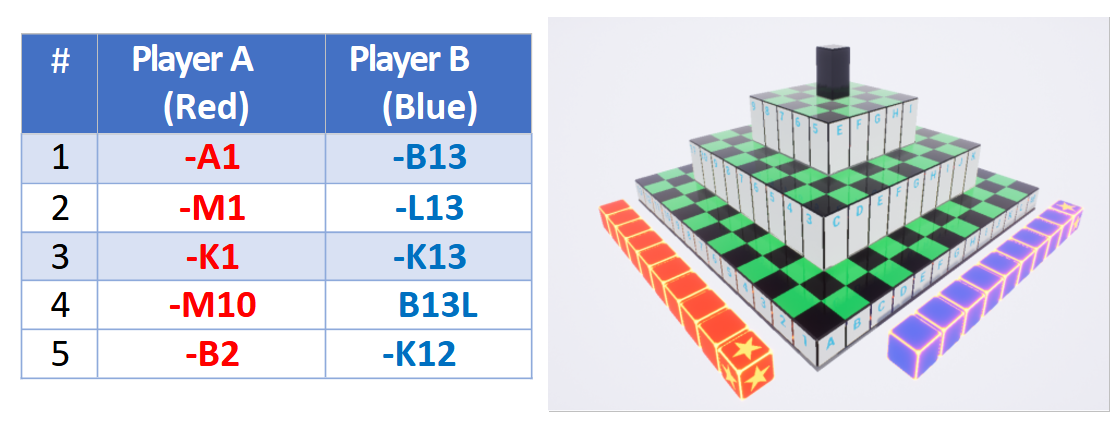
B13L. The blue player creates a double defense to move to the second level by dominating the squares K11 and J11. B2. The red player has some poorly coordinated blocks but aims to move to the second level with a simple defense (which is faster) targeting square C3.
J11. Incorporates by using the opponent's step block to block the entrance and prevent the opponent from adding blocks to the second level.
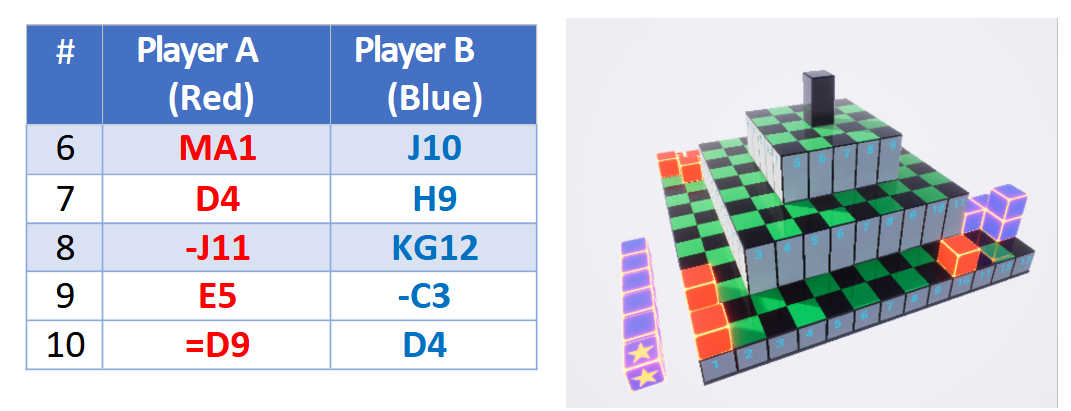
KG12. Moves their step block to G12 to create more routes to the second level, but this is a very good play because the red player uses it to position themselves as well.
10A. Moves the special block to the second level to combine it with the block at D4 to try to bring it to the third level, but risks it being dominated by the blue block at H9.

10B. Dominates the block at D4 with the goal of having the opponent capture it and lose time, exchanging material for time. Additionally, if the opponent doesn't capture it, the red player is threatening the enemy's special block.
4D9. The opponent makes an error by incorporating at E10 instead of moving their special block or capturing the block at D4, as their special block has been dominated by the blue block at D4.

HxD9. Captures the red special block, forcing the red player to rescue it in the future if they wish to recover it.
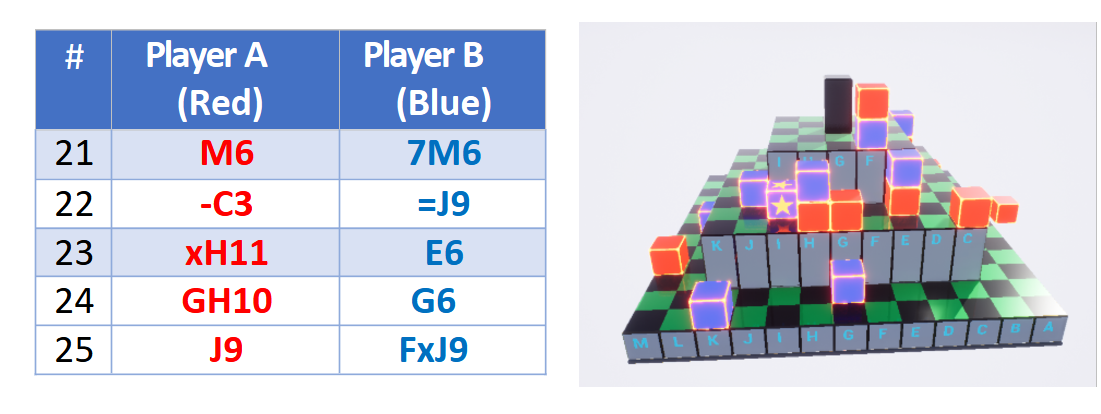
L7. Incorporates a block as a step to create an entry to move the special block up.
FG11. Moves the block to G11 to be able to capture the enemy block at H11.
=I10. Excellent move by incorporating the special block at I10, threatening the H11 square and preventing the red block at C11 from capturing at H11.
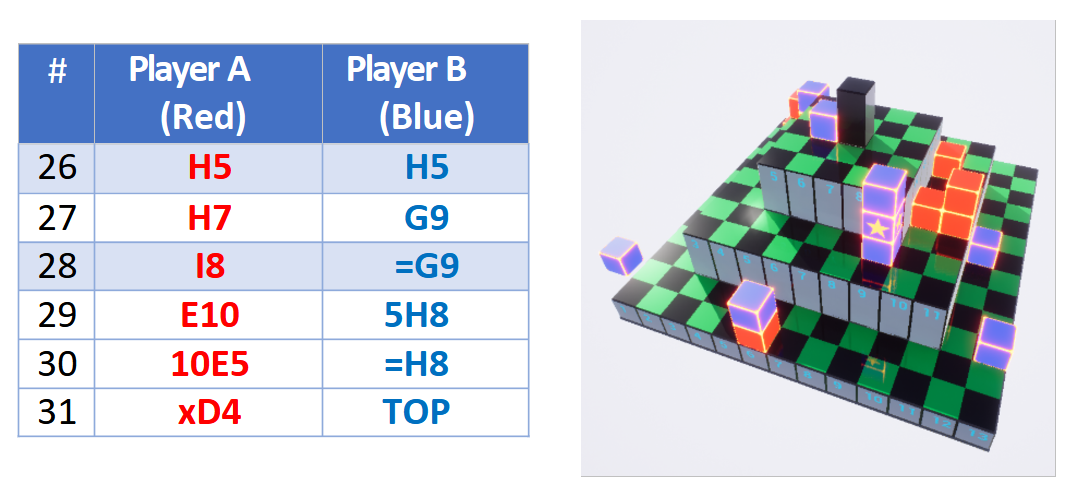
M6. The red block attempts to ascend through the step at L7 but is dominated by the same block.
=J9. Moves the special block to J9 to access the third level. The red block at C11 can now freely capture the blue block at H11. At this point, it is evident that the blue player has a considerable advantage.
E6. Moves the block to E6 to position it at G6, allowing the special block to reach the top.

GH10. The step allows access to the third level and blocks the special block's path to G6.
J9. Dominates J9 to force the blue player to capture it and gain a turn.
=G9. The special block moves to G9, reaching a height above all blocks on the third level. Only one step block is needed to reach the top.
xD4. The red player resigns upon seeing the game is lost and captures the blue block at D4.
Now we will calculate the force and power of each player using the steps explained in previous chapters. Additionally, let's calculate how the new CIMAX values change.

Here we can notice that the winner spent more time on the clock compared to the other player. Furthermore, it is evident that the winner has greater force and power, as expected for the player who reaches the top. The game level does not reach 100 ximas, so it can be considered a medium-level game.
Game 2
J2. The red player places a step block at J2 to, along with the tower at J1, reach the second level. However, the position is not advantageous because it leaves the diagonals open for the opponent to also place their blocks.
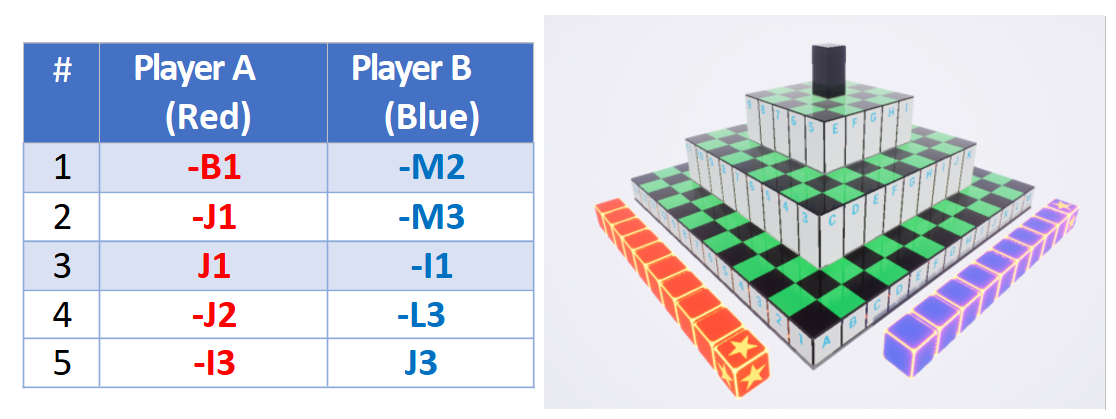
J3. The blue player moves to J3 to block the red blocks' path, although leaving an opening at K3 for the opponent to add a block to the second level.

JI4. Dominates the block at I4, but leaves an opening through which the red blocks can access the second level.
LJ1. Dominates the block at J1 to force the opponent to retreat and capture it to gain a turn.
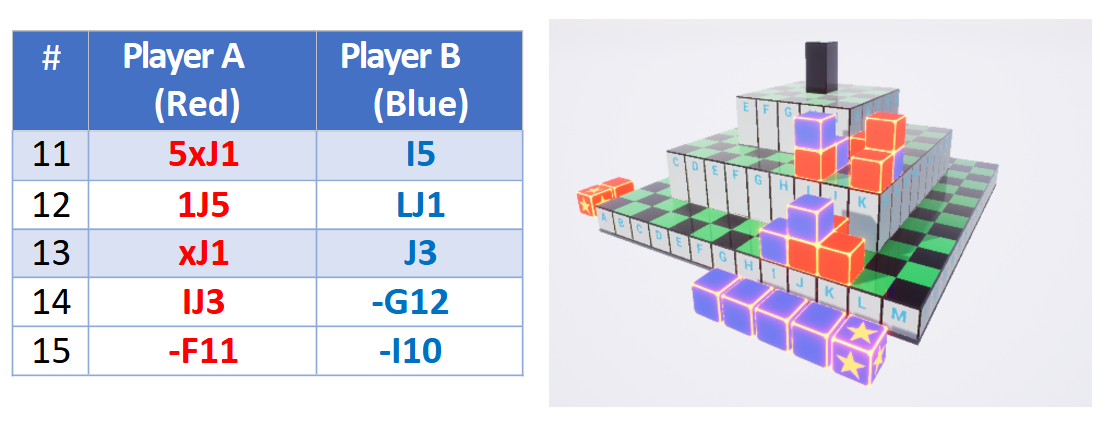
I5. The blue player reaches the third level first, which, in some cases, is associated with a higher probability of winning.
LJ1. Offers a block again for the opponent to capture and retreat.
J3. Now, the blue player removes their step block from the second level and blocks the path to the second level, leaving the red block structure as it was at the beginning of the game. Now, the blue player has an advantage by having a block at the third level.
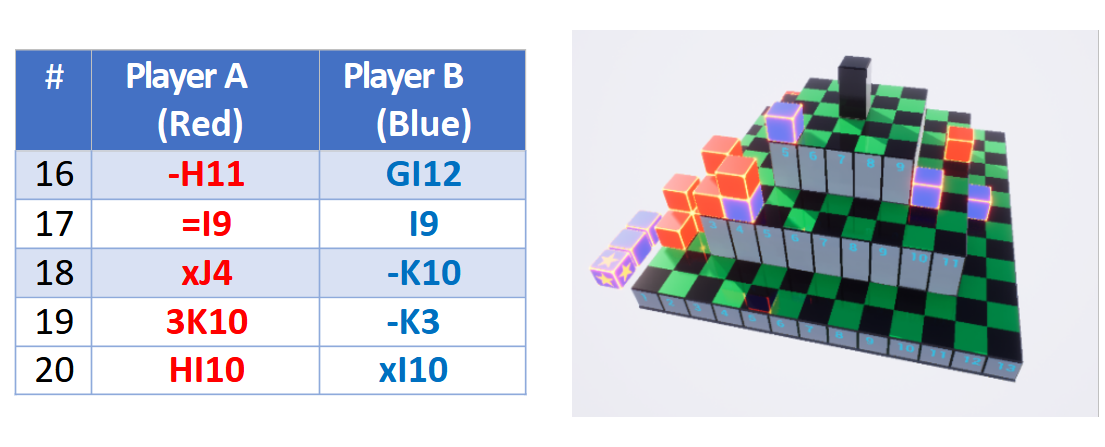
G12. Opens a new entry on the other side of the board to combine with the block at I5.
GI12. Moves the step block to I12, leaving a direct entry to the third level, since the opponent only has one block outside, their special. This move aims to capture the enemy special, which is forced to rise. If not, the blue player would add another block to the third level, giving them more advantage.
xI10. Captures the red block that was going to the third level at I10, freeing the enemy special. This is a poor move by the blue player that may cost them the game, as keeping control of the special would delay the opponent and force them to have at least two red blocks at the third level to release it.
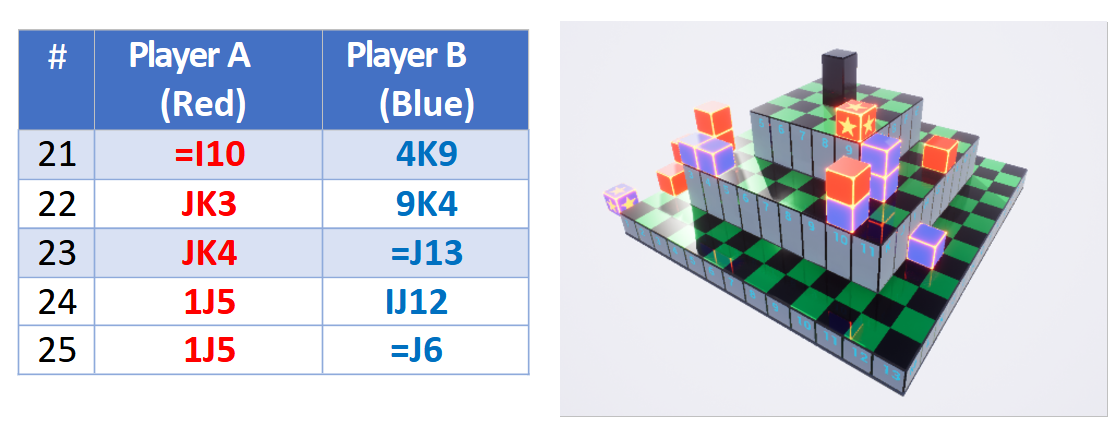
=J13. Incorporates the special at the first level, a poor move since the red player can dominate it with the red blocks in the same row.
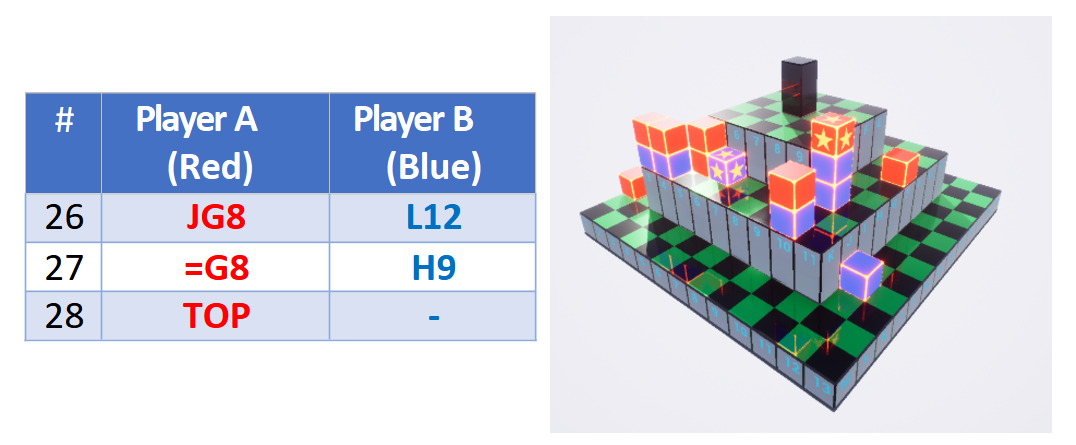
1J5. Prepares the block to position at G8 so that the special can reach the top. There's no need to dominate the enemy special, as the blue player already has the game won. The blue player has lost all their advantage at the third level and has no way to defend.
=G8. At this point, the red player can either choose to win or start capturing and dominating the blue player to gain game force. This would cost a few turns and slightly decrease game power. It's a personal decision: finish the game here or completely defeat the opponent, which is also a valid option. In fact, the opponent may surrender to avoid giving the red player points for game force or face them and gain points as well.
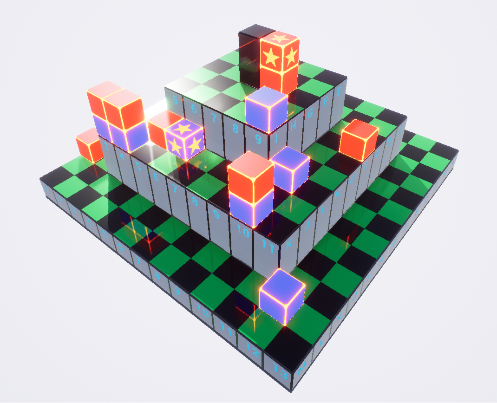
Now, let's calculate the force and power of each player using the steps explained in previous chapters. Additionally, let's calculate how the new CIMAX values change. All is summarized in the following table:

We notice that the winning player nearly doubled the game force of the loser, as they dominated most of the opponent's blocks and controlled the third level. Additionally, the victorious player developed a much higher game power compared to the blue player, whose game power is below 1. Although the skill level exceeds 100 ximas, this is considered a medium-level game where both players made mistakes.
Game 3
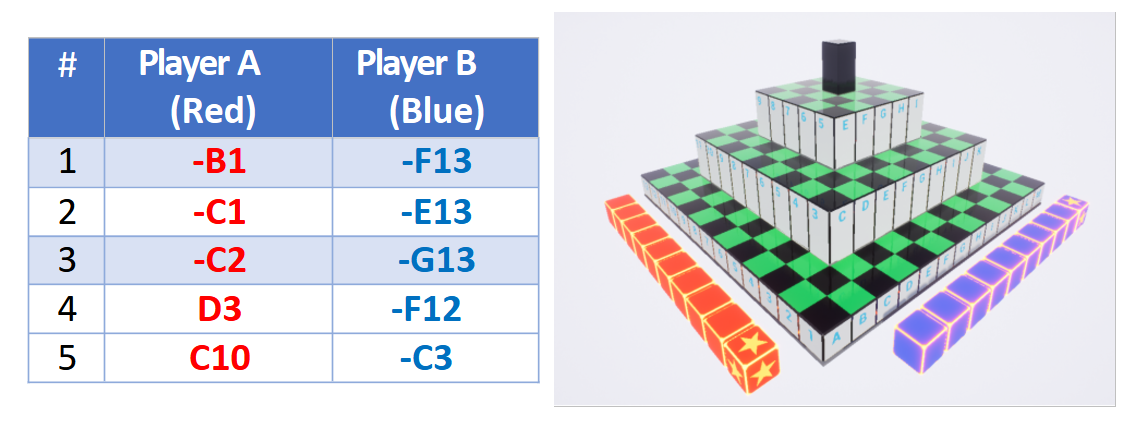
C3. The blue player opts for a triple defense, which is slower to build but more effective when moving blocks to the second level.
C10. The red player moves to C10 to dominate a future step block at row 10, but leaves an opening in their own step block through which the opponent can rise.
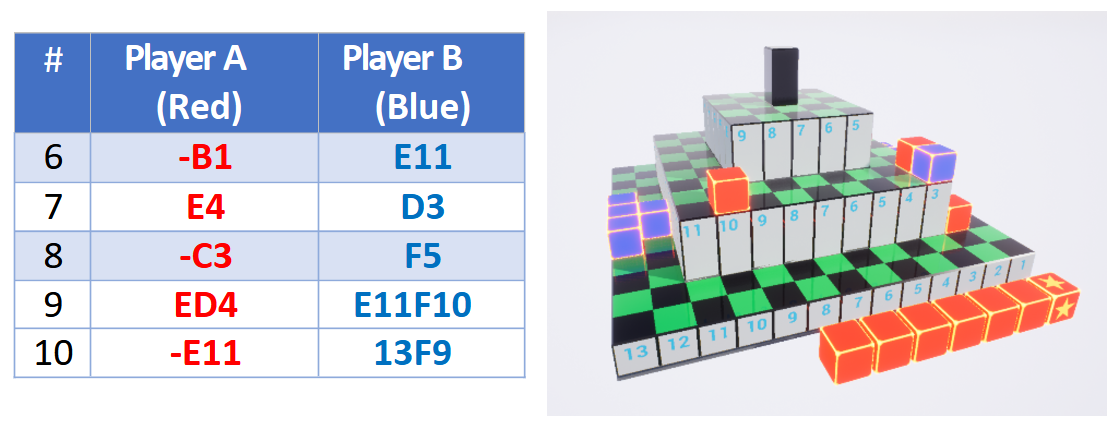
D3. Moves to block the red blocks' path to the third level, but leaves an entry open for the red player to incorporate a block.
-C3. Incorporates using the opponent's step block to block the entry and prevent further block incorporation to the second level. Does not dominate at D3, leaving the access to the third level open for the blue block, doing so to add more blocks to the second level.

E11F10. Acts as a step block to let the F13 block rise to the third level. The red block can dominate it, but won't since the F5 block can capture it. It's a good move, sacrificing the force of the triple defense by leaving openings for the red player to rise to the second level, but gaining speed by moving another block to the third level.

4D9. Moves to D9 so the red block can rise, but this is a bad move since the enemy special can dominate it.

F6H8. Observe how the player leaves the red block free and provokes it to dominate at F10. However, it cannot, as the blue block from H8 protects that position. In case of domination, the red block would be captured.
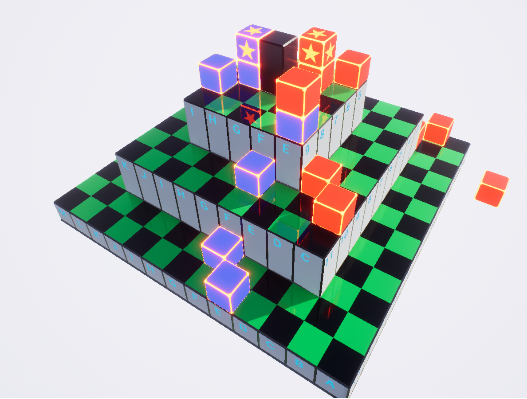
-C10. Now it's the red player's turn to use a block to rise to the third level with protection at D9.
=I8. The special rises over their own block to have the necessary height to pass over any block that might interfere. It's a very strong position; only a step block is needed to reach the top.
-E10. Incorporates to later move it to H8 as a step and let the special reach the top.
HE5. With this move, the player threatens H8, and the enemy special can't move because it might be dominated. In the end, it only delays the inevitable; just move the step block to H7.
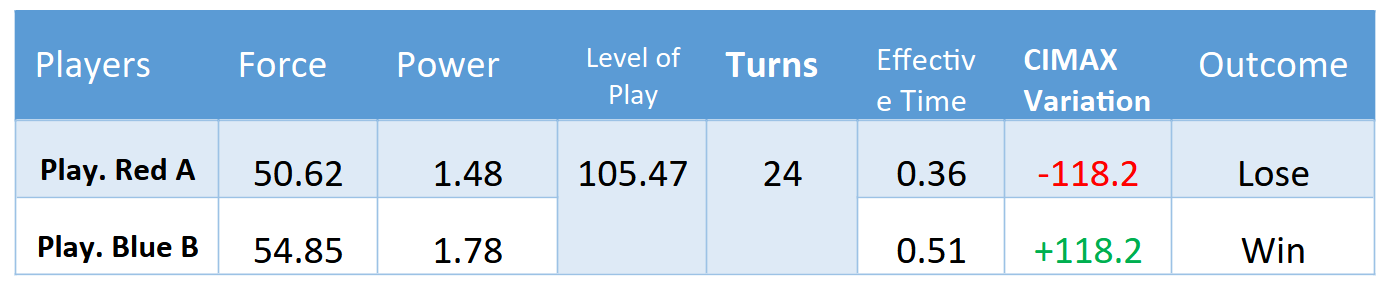
We note that, despite the blue player always having the advantage on the board, the red player ended up dominating the special to the third level, adding some points to the red side. Thus, game forces are almost equal. It was a close game in terms of incorporations and dominations.
The following games are provided for the reader to review and complete the table of magnitudes.